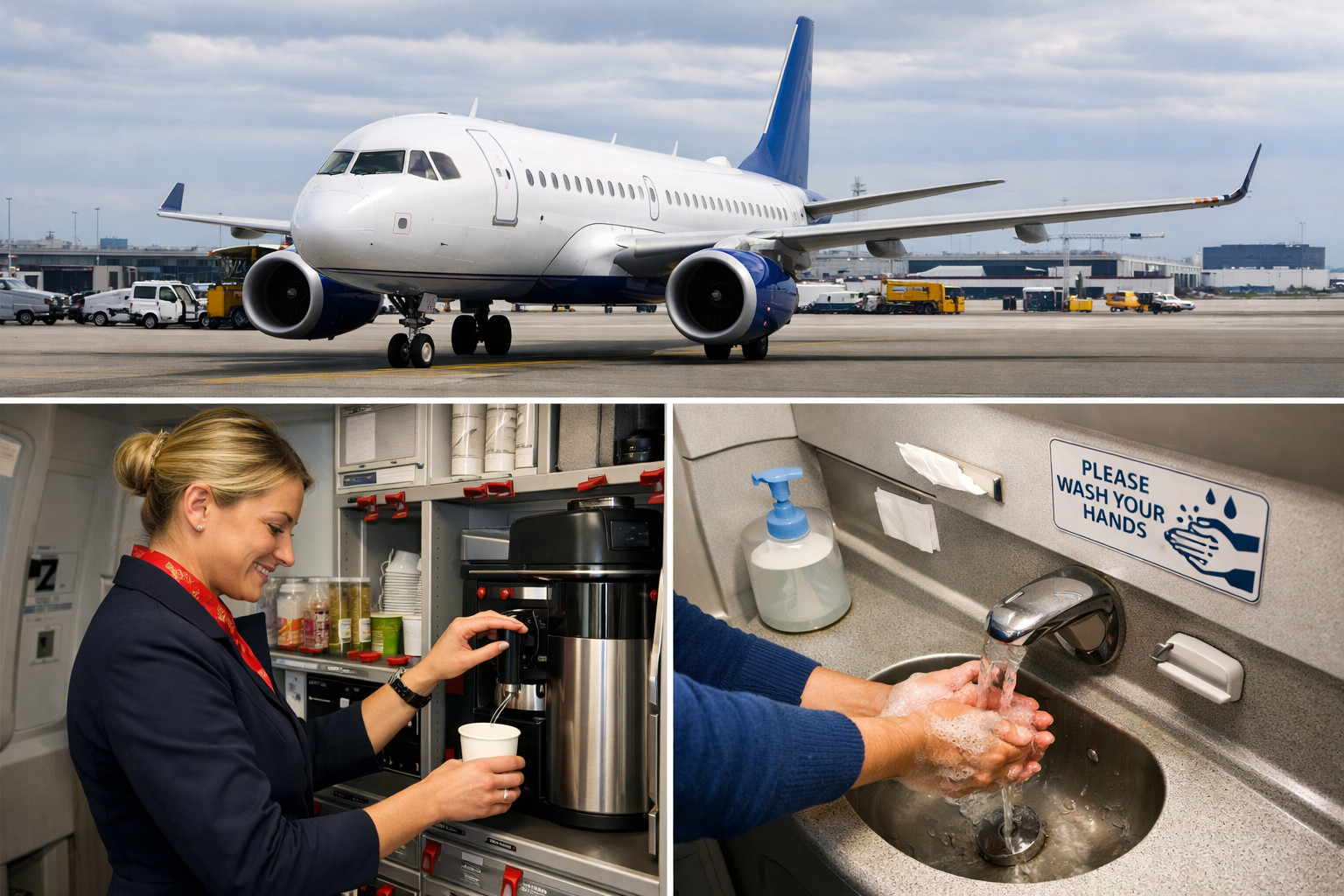
A 2026 Airline Water Study released today by the Center for Food as Medicine and Longevity reveals that the quality of drinking water varies significantly by airline, and many airlines continue to provide passengers with potentially unhealthy water.
Unhealthy water violates the federal government’s Aircraft Drinking Water Rule (ADWR), which was implemented in 2011 and requires airlines to provide passengers and flight crew with safe drinking water.
The 2026 Airline Water Study ranks 10 major and 11 regional airlines by the quality of water they provided onboard flights during a three-year study period (October 1, 2022 through September 30, 2025). Each airline was given a “Water Safety Score” (5.00 = highest rating, 0.00 = lowest) based on five weighted criteria, including violations per aircraft, Maximum Contaminant Level violations for E. coli, indicator-positive rates, public notices, and disinfecting and flushing frequency. A score of 3.5 or better indicates that the airline has relatively safe, clean water and earns a Grade A or B.
“Delta Air Lines and Frontier Airlines win the top spots with the safest water in the sky, and Alaska Airlines finishes No. 3,” says Charles Platkin, PhD, JD, MPH, director of the Center for Food as Medicine and Longevity.
The airlines with the worst score are American Airlines and JetBlue, the study shows. “Nearly all regional airlines need to improve their onboard water safety, with the exception of GoJet Airlines,” Platkin says.
The ADWR requires airlines to take samples from their water tanks to test for coliform bacteria and possible E. coli. Airlines are also required to disinfect and flush each aircraft’s water tank four times per year. Alternatively, an airline may choose to disinfect and flush once a year, but then it must test monthly.
The 2026 Airline Water Study also finds that the Environmental Protection Agency – one of the federal agencies responsible for ensuring safe aircraft drinking water – rarely levies civil penalties to airlines in violation of the ADWR.
Here are the study’s findings:
- The major airlines receiving the highest Water Safety Scores are Delta Air Lines (5.00, Grade A) and Frontier Airlines (4.80, Grade A). Alaska Airlines is a close third at 3.85 (Grade B).
- GoJet Airlines is the highest-rated regional carrier with a score of 3.85 (Grade B).
- Among major airlines, American Airlines has the lowest score of 1.75 (Grade D).
- Nearly all regional airlines have poor Water Safety Scores. Mesa Airlines has the lowest score among rated regional carriers at 1.35 (Grade F), and CommuteAir is second-lowest at 1.60 (Grade D). CommuteAir shows an alarming 33.33% total coliform positive rate.
- The study window analyzed 35,674 total sample locations tested for total coliform bacteria across all airlines. Of these, 949 locations (2.66%) tested positive for total coliform.
- Maximum Contaminant Level violations for E. coli were identified as the strongest downward driver of airline scores. There were 32 such violations across the 21-airline universe during the study window.
- The “Shame on You” Award goes to the EPA for weak enforcement. The study shows that civil penalties for ADWR violations remain extremely rare if at all (we are not able to get an answer).
- Testing for coliform bacteria is important, because their presence in drinking water indicates that disease-causing organisms (pathogens) could be in the water system.
- When an aircraft’s water sample tests positive for coliform, it must be tested again to determine if E. coli is present. If E. coli is not present, the airline must take repeat samples within 24 hours, disinfect and flush the water system within 72 hours, or shut down the water system within 72 hours and then disinfect and flush. If the sample is E. coli positive, the airline must shut off public access to the water system within 24 hours and disinfect and flush.
- The ADWR does not require the same testing as the National Primary Drinking Water Regulations, which includes other microorganisms in addition to total coliform.
- An aircraft flies to numerous destinations and may pump drinking water into its tanks from various sources at domestic and international locations. The water quality onboard also depends on the safety of the equipment used to transfer the water, such as water cabinets, trucks, carts and hoses.
Here’s the bottom-line advice from the Center for Food as Medicine and Longevity. To be extra safe:
- NEVER drink any water onboard that isn’t in a sealed bottle.
- Do not drink coffee or tea onboard.
- Do not wash your hands in the bathroom; use alcohol-based hand sanitizer containing at least 60% alcohol instead.
Airline Water Safety Scores At-a-Glance (5.00 = highest rating, 0.00 = lowest):
Major Airlines
Delta Air Lines: 5.00 (Grade A)
Frontier Airlines: 4.80 (Grade A)
Alaska Airlines: 3.85 (Grade B)
Allegiant Air: 3.65 (Grade B)
Southwest Airlines: 3.30 (Grade C)
Hawaiian Airlines: 3.15 (Grade C)
United Airlines: 2.70 (Grade C)
Spirit Airlines: 2.05 (Grade D)
JetBlue: 1.80 (Grade D)
American Airlines: 1.75 (Grade D)
Regional Airlines
GoJet Airlines: 3.85 (Grade B)
Piedmont Airlines: 3.05 (Grade C)
Sun Country Airlines: 3.00 (Grade C)
Endeavor Air: 2.95 (Grade C)
SkyWest Airlines: 2.40 (Grade D)
Envoy Air: 2.30 (Grade D)
PSA Airlines: 2.25 (Grade D)
Air Wisconsin Airlines: 2.15 (Grade D)
Republic Airways: 2.05 (Grade D)
CommuteAir: 1.60 (Grade D)
Mesa Airlines: 1.35 (Grade F)
Background and Public Health Significance
Commercial aviation serves as an essential mode of transportation for hundreds of millions of passengers annually in the United States. While considerable attention has been devoted to aviation safety in terms of mechanical reliability and operational procedures, the quality and safety of drinking water available to passengers and crew during flight remains a less visible but important public health consideration. Aircraft drinking water systems present unique challenges that distinguish them from terrestrial water systems. Water is loaded onto aircraft at varying airports, stored in onboard tanks under fluctuating temperature and pressure conditions, distributed through complex plumbing networks to galleys and lavatories, and consumed by passengers and flight attendants who have limited alternatives during flight.
Unlike municipal water systems with continuous flow and regular monitoring, aircraft water systems experience periods of stagnation between flights, temperature variations during ascent and descent, and mechanical stress from aircraft operations. These conditions can create environments conducive to biofilm formation and microbial proliferation. Furthermore, the water loaded onto aircraft originates from airport facilities with varying infrastructure quality, and contamination introduced during the servicing process—whether from hoses, truck tanks, or improper handling—can persist in aircraft systems if adequate disinfection and flushing protocols are not rigorously maintained.
The potential health consequences of consuming contaminated aircraft drinking water range from acute gastrointestinal illness to exposure to opportunistic pathogens. Vulnerable populations, including young children, elderly passengers, pregnant women, and immunocompromised individuals, may face elevated risks from waterborne pathogens. For flight attendants who consume onboard water regularly as part of their occupational routine, chronic low-level exposure represents an additional concern. Despite these risks, airline drinking water has historically received less regulatory scrutiny and public attention than other aspects of aviation safety and food service.
Previous Research and the Need for Ongoing Monitoring
In September 2019, dietdetective.com released the first comprehensive comparative analysis of airline drinking water safety. That landmark study examined Aircraft Drinking Water Rule (ADWR) compliance data from 2012 through 2019, revealing that the quality of drinking water varies substantially by airline and that many airlines had provided passengers with unhealthy water in violation of federal safety requirements. The study ranked 10 major and 13 regional airlines using a Water Health Score (5 = highest rating, 0 = lowest) based on 10 criteria, including fleet size, ADWR violations, positive E. coli and coliform water sample reports, and airline cooperation in providing answers to water-quality questions. A score of 3.0 or better was designated as indicating relatively safe, clean water.
The 2019 study’s key findings painted a troubling picture of airline water safety:
Major airline rankings: Alaska Airlines and Allegiant tied for the top spot with scores of 3.3 out of 5.0, followed closely by Hawaiian Airlines at 3.1. At the bottom, Spirit Airlines and JetBlue both scored just 1.0 out of 5.0. Delta Air Lines scored 1.6, American Airlines scored 1.5, and United Airlines scored 1.2.
Regional airline challenges: Nearly all regional airlines, except Piedmont Airlines (which scored an impressive 4.33), showed poor Water Health Scores and a large number of ADWR violations. Republic Airways, which flies for United Express, Delta Connection, and American Eagle, had the lowest score at 0.44. ExpressJet was second-lowest at 0.56 and averaged 3.36 ADWR violations per aircraft.
Violation trends: The number of ADWR violations by all airlines in 2018 was significantly less than in 2012, the first year after the ADWR was enacted. For major airlines, violations had decreased 69% (from 262 to 81), while violations among regional airlines had decreased 71% (from 351 to 103). However, the study noted this decrease might reflect a lack of enforcement by the EPA, which had issued few penalties in recent years.
Enforcement concerns: The study found that the Environmental Protection Agency—one of the federal agencies responsible for ensuring safe aircraft drinking water—rarely levied civil penalties to airlines in violation of the ADWR.
Industry cooperation: The study awarded a “Shame on You” designation to the EPA and nearly all major airlines for their very poor response time and lack of cooperation in answering detailed questions. The EPA didn’t answer most penalty-related questions, and Spirit, Allegiant, and Frontier did not respond to any questions. Very weak responses that didn’t adequately address questions were provided by American, United, and JetBlue, which had large numbers of violations during the study period.
The 2019 study’s bottom-line advice to passengers was unequivocal: Never drink any water onboard that isn’t in a sealed bottle, do not drink coffee or tea made with onboard water, and do not wash hands in aircraft bathrooms—instead, bring hand sanitizer.
The findings from the 2019 study generated significant public attention and media coverage, bringing airline water safety into broader public discourse. However, the passage of six years since that analysis creates an urgent need for updated information. Airlines have had time to respond to public scrutiny, EPA enforcement patterns may have evolved, and fleet compositions and operational practices have changed. Most importantly, passengers and public health stakeholders require current data to assess whether the industry has improved its performance in response to the 2019 findings or whether systemic problems persist.
Some of the most dramatic questions raised by comparing the 2019 baseline to current conditions include: Has Delta Air Lines, which scored just 1.6 in 2019, improved its water safety practices? Have JetBlue and Spirit, tied for last place in 2019, addressed their significant compliance challenges? Has the regional airline sector, which showed pervasive problems in 2019, made meaningful progress? And critically, has the EPA increased enforcement efforts, or does the regulatory gap identified in 2019 persist?
This 2026 study represents a continuation of systematic airline water safety monitoring using a refined methodology specifically designed to provide actionable, comparative information based on the most recent three years of compliance data.
The United States Environmental Protection Agency (EPA) established the Aircraft Drinking Water Rule under the authority of the Safe Drinking Water Act. The rule, which became effective in 2011, applies to aircraft operated by U.S. carriers that have onboard drinking water systems and serve passengers or crew on flights with at least one U.S. point of service.
The Aircraft Drinking Water Rule establishes several key requirements for covered carriers:
Routine monitoring and testing: Airlines must collect and analyze water samples from aircraft for the presence of total coliform bacteria and, when total coliform is detected, for Escherichia coli (E. coli). Total coliform bacteria serve as indicator organisms; their presence suggests potential fecal contamination or inadequate disinfection, even if the organisms themselves are not necessarily pathogenic. The detection of E. coli, a fecal coliform bacterium, constitutes a Maximum Contaminant Level (MCL) violation and signals more serious contamination requiring immediate corrective action. Testing for coliform bacteria is important because their presence in drinking water indicates that disease-causing organisms (pathogens) could be in the water system.
Disinfection and flushing: When monitoring reveals coliform contamination, airlines must disinfect and flush the affected aircraft water system according to EPA-approved procedures. Airlines are required to disinfect and flush each aircraft’s water tank four times per year, or alternatively, an airline may choose to disinfect and flush once a year if it tests monthly. Disinfection typically involves super-chlorination of the water system followed by thorough flushing to remove both the disinfectant residue and biofilm. When an aircraft’s water sample tests positive for coliform, it must be tested again to determine if E. coli is present. If E. coli is not present, the airline must take repeat samples within 24 hours and either disinfect and flush the water system within 72 hours or shut down the water system within 72 hours and then disinfect and flush. If the sample is E. coli positive, the airline must shut off public access to the water system within 24 hours and disinfect and flush.
Corrective action and public notification: When E. coli is detected (a Maximum Contaminant Level violation), airlines must immediately take the aircraft water system out of service, provide alternative drinking water sources to passengers and crew, notify passengers through posted notices, disinfect and flush the system, and conduct follow-up testing to confirm the contamination has been eliminated. Public notices must inform passengers that the water system is unavailable and that alternative drinking water is being provided.
Record-keeping and reporting: Airlines must maintain detailed records of all monitoring, testing, disinfection, flushing, violations, and corrective actions, and submit these records to EPA through a centralized electronic reporting portal.
It is important to note that the ADWR does not require the same comprehensive testing as the National Primary Drinking Water Regulations, which includes testing for other microorganisms in addition to total coliform. Additionally, aircraft fly to numerous destinations and may pump drinking water into their tanks from various sources at domestic and international locations. The water quality onboard also depends on the safety of the equipment used to transfer the water, such as water cabinets, trucks, carts, and hoses—factors that can introduce contamination even when source water meets safety standards.
The Aircraft Drinking Water Rule represents a significant regulatory framework for ensuring aircraft water safety. However, compliance data alone does not automatically translate into public awareness or competitive pressure for improved performance. Systematic analysis and transparent public reporting of airline-specific performance metrics remain essential for translating regulatory data into actionable public health information.
Knowledge Gaps and Study Rationale
Despite the 2019 baseline study and ongoing EPA data collection, several important questions remain unanswered:
How have airline drinking water safety practices evolved? The 2019 study provided a snapshot of the industry during the first seven years of ADWR implementation. Whether airlines have improved their performance in response to public scrutiny, maintained similar patterns, or experienced deterioration requires fresh analysis of recent compliance records.
Which airlines currently demonstrate the strongest and weakest water safety performance? Rankings from 2019 may not reflect current conditions. Some carriers that performed poorly may have implemented significant improvements, while previously high-performing airlines may have experienced setbacks. Updated comparative rankings using current data are essential for informed passenger decision-making.
What is the current magnitude of contamination risk? Total coliform detection rates, E. coli Maximum Contaminant Level violations, and compliance patterns may have shifted substantially since the 2019 analysis. Quantifying current risk levels across the industry provides an updated baseline for assessing future trends.
Are there systematic differences between major airlines and regional carriers? The 2019 study demonstrated that regional airlines faced particular challenges, but whether these patterns persist or have changed requires examination of current data.
How effective are public notification and response practices? Beyond detecting contamination, the adequacy of airline responses when violations occur—specifically whether airlines consistently provide alternative water sources and remove contaminated systems from service—remains a critical but understudied dimension of passenger protection. The 2019 study noted significant gaps in airline cooperation and transparency; whether these have improved is unknown.
Has EPA enforcement evolved? The 2019 study identified limited EPA enforcement and civil penalties as a systemic concern. Whether regulatory oversight has strengthened since 2019 requires examination of current violation and penalty patterns.
This study addresses these knowledge gaps through comprehensive analysis of the most recent three-year period of Aircraft Drinking Water Rule compliance data, using enhanced methodological rigor and transparency compared to the 2019 study.
Study Objectives
The primary objective of this study is to generate an evidence-based, transparent scorecard that ranks airlines according to multiple indicators of drinking water safety derived from Aircraft Drinking Water Rule compliance data for the period October 1, 2022, through September 30, 2025. Specific aims include:
- Quantify total coliform and E. coli detection rates across airlines, normalized by fleet size to enable fair comparisons between carriers of different scales.
- Identify Maximum Contaminant Level violations for E. coli and assess how these serious contamination events are distributed across the airline industry.
- Evaluate compliance with public notification requirements, including whether airlines consistently provide alternative drinking water and remove contaminated systems from service when violations occur.
- Assess preventive maintenance practices by measuring the frequency of disinfection and flushing events relative to fleet size.
- Develop a composite Water Safety Score that integrates multiple performance dimensions into a single metric, allowing passengers and stakeholders to compare airlines and identify both leaders and laggards in drinking water safety.
- Provide actionable guidance for passengers on risk-reduction strategies when traveling by air, informed by current patterns in compliance data.
- Document changes in airline performance since the 2019 baseline study, identifying carriers that have improved dramatically, those that have maintained consistent performance, and those where challenges persist or have worsened.
Study Approach and Report Structure
This study employs a retrospective, observational design using Aircraft Drinking Water Rule records submitted to EPA by airlines and exported from the EPA reporting portal. The analysis covers a three-year study window from October 1, 2022, through September 30, 2025 (inclusive), and includes 21 airlines: 10 major carriers and 11 regional carriers.
Data sources include five comma-separated value exports containing violation records, operational events (disinfection, flushing, sampling, and water system restrictions), laboratory sample results, and public notices. Fleet size for each airline was determined by counting unique aircraft tail numbers appearing in any of the data files during the study window, providing a consistent denominator for calculating per-aircraft rates.
The Water Safety Score, ranging from 0.00 to 5.00, combines five weighted sub-scores reflecting violations per aircraft, Maximum Contaminant Level violations for E. coli, indicator-positive rates (total coliform present with E. coli absent), public notices per 100 aircraft, and disinfecting and flushing frequency. Penalties are applied for inadequate responses to public notice requirements, specifically when airlines fail to clearly turn off contaminated water systems or provide alternative drinking water.
Compared to the 2019 study methodology, this analysis incorporates several enhancements: (1) use of direct EPA data exports rather than manual data compilation, (2) explicit handling of violation date overlap calculations with transparency about missing data, (3) extraction of sample-location level total coliform results from operational event details, (4) formal weighting of score components based on public health significance, and (5) explicit penalty structures for inadequate public notification responses.
This report presents validated study-wide totals for key contamination metrics, comparative rankings of airlines by Water Safety Score with assigned letter grades, detailed airline-specific profiles showing the underlying data driving each score, passenger risk-reduction guidance, methodological transparency including quintile thresholds and calculation procedures, and discussion of study limitations. By making these findings accessible to the public, this study aims to empower passengers with information to make informed travel choices, encourage airlines to prioritize drinking water safety through competitive transparency, and contribute to the evidence base for public health policy in aviation.
Study window: October 1, 2022 through September 30, 2025 (inclusive)
Airline universe: 10 major airlines and 11 regional airlines (21 airlines total)
Data sources: Five comma separated value exports from the Aircraft Drinking Water Rule reporting portal provided to the Center for Food as Medicine and Longevity
Primary outputs: Water Safety Score (0.00 to 5.00) and airline-level drinking water indicators
Executive Summary
Airplane drinking water is stored in onboard tanks and distributed through plumbing to galleys and lavatories. These systems can face stagnation, temperature fluctuation, and maintenance complexity, all of which can contribute to microbial contamination risk or persistent hygiene challenges.
This study presents a comparative scorecard for 21 airlines using Aircraft Drinking Water Rule compliance, operational, sampling, and public notice records. Each airline is assigned a Water Safety Score on a 0.00 to 5.00 scale. Higher scores indicate stronger performance across the indicators used in this study.
Validated study-wide totals (21-airline universe, study window)
Total coliform monitoring (from sample-location results embedded in Aircraft Drinking Water System Operations Sample events):
- Total sample locations tested for total coliform bacteria: 35,674
- Total sample locations where total coliform bacteria were present: 949 (2.66 percent)
- Total sample locations where total coliform bacteria were present and Escherichia coli was absent: 897 (2.51 percent)
- Among total coliform positive locations (949 total): Escherichia coli was absent in 897 locations, Escherichia coli was present in 50 locations, and Escherichia coli was reported as did not speciate in 2 locations.
Violations (from Violations Report, overlap method):
- Total Aircraft Drinking Water Rule violations: 931
- Maximum Contaminant Level violations for Escherichia coli: 32
Important note about missing violation end dates (for transparency and reproducibility):
- In the provided Violations Report export, a large number of violation rows have a missing Date Violation Ended value. Because the overlap method requires both a begin date and an end date, those rows cannot be evaluated for overlap and are excluded from overlap-based counting.
Major airlines versus regional airlines (total coliform monitoring)
Major airlines:
- Total sample locations tested: 26,034
- Total coliform positive locations: 491 (1.89 percent)
- Total coliform positive with Escherichia coli absent: 461 (1.77 percent)
Regional airlines:
- Total sample locations tested: 9,640
- Total coliform positive locations: 458 (4.75 percent)
- Total coliform positive with Escherichia coli absent: 436 (4.52 percent)
Key findings (ranked results, based on Water Safety Score)
Highest-scoring major airline: Delta Air Lines Incorporated (5.00 out of 5.00, Grade A)
Lowest-scoring major airline: American Airlines Incorporated (1.75 out of 5.00, Grade D)
Highest-scoring regional airline: GoJet Airlines Limited Liability Company (3.85 out of 5.00, Grade B)
Lowest-scoring regional airline with records in this window: Mesa Airlines Incorporated (1.35 out of 5.00, Grade F)
Bottom line for passengers
This is a compliance and monitoring signal scorecard, not a guarantee of water quality on any specific flight. Still, if you want to reduce risk:
- Prefer sealed bottled beverages.
- Avoid consuming unbottled aircraft tap water.
- Avoid coffee and tea made with onboard tap water when feasible.
- Use alcohol-based hand sanitizer containing at least 60 percent alcohol when soap-and-water options are limited.
Study Questions
- Which airlines show the strongest and weakest aircraft drinking water safety signals during the study window after normalizing by fleet size?
- Where do Maximum Contaminant Level violations for Escherichia coli cluster across airlines?
- How often do airlines show total coliform bacteria present in sampling location monitoring, and how do those rates compare across carriers?
Methods
Study design and objective
The Center for Food as Medicine and Longevity conducted a retrospective, observational analysis of Aircraft Drinking Water Rule records to generate a comparative airline drinking water scorecard for a fixed three-year period.
Data sources
Five comma separated value files exported from the United States Environmental Protection Agency Aircraft Drinking Water Rule reporting portal were analyzed:
- Violations Report (one row per Aircraft Drinking Water Rule violation record).
- Aircraft Drinking Water System Operations (one row per operational event; includes disinfecting and flushing events, sampling events, and restriction of public access events).
- Aircraft Sampling Operations (one row per laboratory sample result; includes a field for Escherichia coli present or absent, but this export does not include an explicit total coliform result field).
- Public Notices Report (one row per public notice; includes whether the water system was turned off and whether an alternative was provided).
- Aircraft Disinfecting and Flushing Operations (used as a cross-check subset of disinfecting and flushing events).
Study window and file-specific filters
All files were filtered to October 1, 2022 through September 30, 2025 (inclusive).
Violations Report: Violations were counted using an overlap method that requires a begin date and an end date. A violation record was included if Date Violation Began was on or before September 30, 2025 and Date Violation Ended was on or after October 1, 2022. Violation rows with missing Date Violation Ended values cannot be evaluated for overlap and are excluded from overlap-based counting.
Aircraft Drinking Water System Operations: Events were included if the event date fell within the study window.
Aircraft Sampling Operations: Laboratory results were included if Results Received On fell within the study window.
Public Notices Report: Notices were included if the notice date fell within the study window.
Airline universe
The analysis was restricted to a fixed universe of 1 airlines (10 major airlines and 11 regional airlines). Airlines not on this list were excluded from scoring. If an airline had no records in the provided files during the study window, it is listed with fleet size equal to 0 and marked not rated.
Fleet size definition
Fleet size for each airline was defined as the number of unique aircraft tail numbers appearing for that airline in any of the following within the study window:
- Violations Report
- Aircraft Drinking Water System Operations
- Aircraft Sampling Operations
- Public Notices Report
This yields a consistent per-aircraft denominator for rate calculations.
How total coliform present is identified in these files
In this export set, total coliform present or absent is available at the sample-location level inside the Aircraft Drinking Water System Operations file for rows where Event equals Sample. These rows contain a Details field that includes two sampling locations per row, each introduced by the literal string Location:.
Within each location block, the total coliform result appears as text in forms including:
- Total Coliform:<b>Present</b>
- Total Coliform:<b>Absent</b>
and sometimes without bold tags (for example, Total Coliform: Present).
For this study, the Details field was parsed by splitting each Sample row into its two Location blocks, removing markup tags such as <b> and </b> (and other HTML tags when present), and extracting the total coliform result from each block. Each Location block counted as one sample location tested. A location was counted as total coliform positive if the extracted value was present.
The same location block also includes Escherichia coli as present, absent, or did not speciate. This allowed the study to report both total coliform positives and indicator positives (total coliform present with Escherichia coli absent).
How Maximum Contaminant Level violations for Escherichia coli are identified
Maximum Contaminant Level violations for Escherichia coli were counted when Violation Type equals Maximum Contaminant Level (Escherichia coli) in the violations export. Violations of type Monitoring (Escherichia coli speciate) are not counted as Maximum Contaminant Level violations.
Public notices and response penalties
Public notices were taken from the Public Notices Report. Two response fields were used for penalty logic:
- Was Water System Turned Off?
- Alternative Provided?
A response was treated as affirmative only when the field value was clearly Yes (or equivalent affirmative forms). Any non-affirmative or blank value was treated as not affirmative.
Water Safety Score (0.00 to 5.00)
Each airline received five sub-scores on a 1 to 5 scale, combined using fixed weights:
- Violations per aircraft: 20 percent (lower is scored better, using quintiles; 0 is always scored as 5).
- Maximum Contaminant Level violations for Escherichia coli: 35 percent (hard step penalty; 0 is scored as 5, 1 is scored as 2, 2 or more is scored as 1).
- Indicator-positive rate (total coliform present with Escherichia coli absent, percent): 20 percent (lower is scored better, using quintiles; 0 is always scored as 5).
- Public notices per 100 aircraft: 15 percent (lower is scored better, using quintiles; 0 is always scored as 5).
- Disinfecting and flushing events per aircraft: 10 percent (higher is scored better, using quintiles).
Public notice response penalties were then applied:
- Subtract 0.5 if the airline had at least one public notice where an alternative was not clearly provided.
- Subtract 1.0 if the airline had at least one public notice where the water system was not clearly turned off.
Quintile threshold handling for reproducibility: for quintile-based sub-scores, values equal to a percentile threshold are assigned to the higher-performing bin (for example, greater than or equal to the 20th percentile threshold is scored in the 20th-to-40th percentile bin, and greater than or equal to the 80th percentile threshold is scored in the top bin).
Final score is bounded at a minimum of 0.00 and reported to two decimal places.
Grades were assigned as follows:
- 4.50 or higher: Grade A
- 3.50 to 4.49: Grade B
- 2.50 to 3.49: Grade C
- 1.50 to 2.49: Grade D
- Below 1.50: Grade F
Results
Major airlines ranked best to worst (based on Water Safety Score)
- Delta Air Lines Incorporated (5.00, Grade A)
- Frontier Airlines Incorporated (4.80, Grade A)
- Alaska Airlines Incorporated (3.85, Grade B)
- Allegiant Air Limited Liability Company (3.65, Grade B)
- Southwest Airlines Company (3.30, Grade C)
- Hawaiian Airlines Incorporated (3.15, Grade C)
- United Airlines Incorporated (2.70, Grade C)
- Spirit Airlines Incorporated (2.05, Grade D)
- JetBlue Airways Corporation (1.80, Grade D)
- American Airlines Incorporated (1.75, Grade D)
Regional airlines ranked best to worst (based on Water Safety Score; airlines with fleet size greater than 0)
- GoJet Airlines Limited Liability Company (3.85, Grade B)
- Piedmont Airlines Incorporated (3.05, Grade C)
- Sun Country Airlines (3.00, Grade C)
- Endeavor Air Incorporated (2.95, Grade C)
- SkyWest Airlines Incorporated (2.40, Grade D)
- Envoy Air Incorporated (2.30, Grade D)
- PSA Airlines Incorporated (2.25, Grade D)
- Air Wisconsin Airlines Corporation (2.15, Grade D)
- Republic Airways Incorporated (2.05, Grade D)
- CommuteAir Limited Liability Company (1.60, Grade D)
- Mesa Airlines Incorporated (1.35, Grade F)
What drove the scores
- Maximum Contaminant Level violations for Escherichia coli were the strongest downward driver. Because this component carries the largest weight and uses a hard step penalty, airlines with multiple Maximum Contaminant Level violations for Escherichia coli are structurally pushed toward lower scores.
- The indicator-positive rate (total coliform present with Escherichia coli absent) varied widely across airlines. Across all airlines, the indicator-positive rate was 2.51 percent. The indicator-positive rate was higher among regional airlines (4.52 percent) than among major airlines (1.77 percent) in this study window.
- Violations per aircraft ranged from very low to very high. Some airlines showed very low violations per aircraft (for example, Delta Air Lines Incorporated and Frontier Airlines Incorporated). Others showed high violations per aircraft (for example, Sun Country Airlines, Republic Airways Incorporated, and JetBlue Airways Corporation), which materially reduced their scores.
- Public notice response behavior is explicitly penalized when required fields are not clearly affirmative. In this study window, the score includes response penalties for:
- Alaska Airlines Incorporated (alternative not clearly provided on at least one notice).
- SkyWest Airlines Incorporated (alternative not clearly provided on at least one notice).
- American Airlines Incorporated (alternative not clearly provided on at least one notice and water system not clearly turned off on at least one notice).
Detailed Airline Profiles
Major airlines
Delta Air Lines Incorporated
Water Safety Score: 5.00 out of 5.00
Grade: A
Fleet size: 1,028
Aircraft Drinking Water Rule violations (overlap method): 9
Violations per aircraft: 0.0088
Maximum Contaminant Level violations for Escherichia coli: 0
Total coliform locations tested: 5,996
Total coliform positive locations: 28 (0.47 percent)
Total coliform positive with Escherichia coli absent: 28 (0.47 percent)
Public notices per 100 aircraft: 0.19
Disinfecting and flushing events per aircraft: 11.042
Comments: Delta shows no Maximum Contaminant Level violations for Escherichia coli and a low indicator-positive rate (total coliform present with Escherichia coli absent).
Frontier Airlines Incorporated
Water Safety Score: 4.80 out of 5.00
Grade: A
Fleet size: 171
Aircraft Drinking Water Rule violations (overlap method): 1
Violations per aircraft: 0.0058
Maximum Contaminant Level violations for Escherichia coli: 0
Total coliform locations tested: 952
Total coliform positive locations: 13 (1.37 percent)
Total coliform positive with Escherichia coli absent: 10 (1.05 percent)
Public notices per 100 aircraft: 0.58
Disinfecting and flushing events per aircraft: 10.006
Comments: Frontier shows very low violations per aircraft and no Maximum Contaminant Level violations for Escherichia coli.
Alaska Airlines Incorporated
Water Safety Score: 3.85 out of 5.00
Grade: B
Fleet size: 288
Aircraft Drinking Water Rule violations (overlap method): 8
Violations per aircraft: 0.0278
Maximum Contaminant Level violations for Escherichia coli: 0
Total coliform locations tested: 1,484
Total coliform positive locations: 13 (0.88 percent)
Total coliform positive with Escherichia coli absent: 13 (0.88 percent)
Public notice penalty applied: Yes (alternative not clearly provided on at least one notice)
Public notices per 100 aircraft: 2.08
Disinfecting and flushing events per aircraft: 9.684
Comments: Alaska shows no Maximum Contaminant Level violations for Escherichia coli and a low indicator-positive rate, with one public notice response penalty.
Allegiant Air Limited Liability Company
Water Safety Score: 3.65 out of 5.00
Grade: B
Fleet size: 141
Aircraft Drinking Water Rule violations (overlap method): 9
Violations per aircraft: 0.0638
Maximum Contaminant Level violations for Escherichia coli: 1
Total coliform locations tested: 534
Total coliform positive locations: 7 (1.31 percent)
Total coliform positive with Escherichia coli absent: 3 (0.56 percent)
Public notices per 100 aircraft: 1.42
Disinfecting and flushing events per aircraft: 10.617
Comments: Allegiant has one Maximum Contaminant Level violation for Escherichia coli, which is treated as a serious signal in the scoring model.
Southwest Airlines Company
Water Safety Score: 3.30 out of 5.00
Grade: C
Fleet size: 914
Aircraft Drinking Water Rule violations (overlap method): 30
Violations per aircraft: 0.0328
Maximum Contaminant Level violations for Escherichia coli: 5
Total coliform locations tested: 5,180
Total coliform positive locations: 61 (1.18 percent)
Total coliform positive with Escherichia coli absent: 55 (1.06 percent)
Public notices per 100 aircraft: 1.31
Disinfecting and flushing events per aircraft: 10.629
Comments: Southwest shows multiple Maximum Contaminant Level violations for Escherichia coli, a high-severity driver in the score.
Hawaiian Airlines Incorporated
Water Safety Score: 3.15 out of 5.00
Grade: C
Fleet size: 65
Aircraft Drinking Water Rule violations (overlap method): 48
Violations per aircraft: 0.7385
Maximum Contaminant Level violations for Escherichia coli: 0
Total coliform locations tested: 394
Total coliform positive locations: 17 (4.31 percent)
Total coliform positive with Escherichia coli absent: 17 (4.31 percent)
Public notices per 100 aircraft: 10.77
Disinfecting and flushing events per aircraft: 11.569
Comments: Hawaiian shows high violations per aircraft and an elevated indicator-positive rate in this dataset.
United Airlines Incorporated
Water Safety Score: 2.70 out of 5.00
Grade: C
Fleet size: 1,063
Aircraft Drinking Water Rule violations (overlap method): 105
Violations per aircraft: 0.0988
Maximum Contaminant Level violations for Escherichia coli: 6
Total coliform locations tested: 4,076
Total coliform positive locations: 97 (2.38 percent)
Total coliform positive with Escherichia coli absent: 90 (2.21 percent)
Public notices per 100 aircraft: 0.00
Disinfecting and flushing events per aircraft: 10.589
Comments: United shows multiple Maximum Contaminant Level violations for Escherichia coli and an indicator-positive rate above the major-airline group average.
Spirit Airlines Incorporated
Water Safety Score: 2.05 out of 5.00
Grade: D
Fleet size: 248
Aircraft Drinking Water Rule violations (overlap method): 37
Violations per aircraft: 0.1492
Maximum Contaminant Level violations for Escherichia coli: 1
Total coliform locations tested: 1,348
Total coliform positive locations: 64 (4.75 percent)
Total coliform positive with Escherichia coli absent: 63 (4.67 percent)
Public notices per 100 aircraft: 20.97
Disinfecting and flushing events per aircraft: 9.290
Comments: Spirit shows an elevated indicator-positive rate and very high public notices per 100 aircraft.
JetBlue Airways Corporation
Water Safety Score: 1.80 out of 5.00
Grade: D
Fleet size: 336
Aircraft Drinking Water Rule violations (overlap method): 220
Violations per aircraft: 0.6548
Maximum Contaminant Level violations for Escherichia coli: 2
Total coliform locations tested: 1,976
Total coliform positive locations: 112 (5.67 percent)
Total coliform positive with Escherichia coli absent: 106 (5.36 percent)
Public notices per 100 aircraft: 8.63
Disinfecting and flushing events per aircraft: 10.182
Comments: JetBlue shows a high violations-per-aircraft burden and an elevated indicator-positive rate.
American Airlines Incorporated
Water Safety Score: 1.75 out of 5.00
Grade: D
Fleet size: 995
Aircraft Drinking Water Rule violations (overlap method): 23
Violations per aircraft: 0.0231
Maximum Contaminant Level violations for Escherichia coli: 3
Total coliform locations tested: 4,094
Total coliform positive locations: 79 (1.93 percent)
Total coliform positive with Escherichia coli absent: 76 (1.86 percent)
Public notice penalties applied: Yes (alternative not clearly provided and water system not clearly turned off on at least one notice)
Public notices per 100 aircraft: 2.31
Disinfecting and flushing events per aircraft: 11.563
Comments: American’s score is materially lowered by public notice response penalties and Maximum Contaminant Level violations for Escherichia coli.
Regional airlines
GoJet Airlines Limited Liability Company
Water Safety Score: 3.85 out of 5.00
Grade: B
Fleet size: 58
Aircraft Drinking Water Rule violations (overlap method): 0
Maximum Contaminant Level violations for Escherichia coli: 0
Total coliform locations tested: 286
Total coliform positive locations: 12 (4.20 percent)
Total coliform positive with Escherichia coli absent: 12 (4.20 percent)
Public notices per 100 aircraft: 5.17
Disinfecting and flushing events per aircraft: 8.466
Piedmont Airlines Incorporated
Water Safety Score: 3.05 out of 5.00
Grade: C
Fleet size: 81
Aircraft Drinking Water Rule violations (overlap method): 11
Maximum Contaminant Level violations for Escherichia coli: 0
Total coliform locations tested: 408
Total coliform positive locations: 47 (11.52 percent)
Total coliform positive with Escherichia coli absent: 47 (11.52 percent)
Public notices per 100 aircraft: 9.88
Disinfecting and flushing events per aircraft: 9.247
Sun Country Airlines
Water Safety Score: 3.00 out of 5.00
Grade: C
Fleet size: 46
Aircraft Drinking Water Rule violations (overlap method): 78
Maximum Contaminant Level violations for Escherichia coli: 0
Total coliform locations tested: 1,034
Total coliform positive locations: 17 (1.64 percent)
Total coliform positive with Escherichia coli absent: 17 (1.64 percent)
Public notices per 100 aircraft: 26.09
Disinfecting and flushing events per aircraft: 6.130
Endeavor Air Incorporated
Water Safety Score: 2.95 out of 5.00
Grade: C
Fleet size: 169
Aircraft Drinking Water Rule violations (overlap method): 10
Maximum Contaminant Level violations for Escherichia coli: 1
Total coliform locations tested: 668
Total coliform positive locations: 11 (1.65 percent)
Total coliform positive with Escherichia coli absent: 10 (1.50 percent)
Public notices per 100 aircraft: 6.51
Disinfecting and flushing events per aircraft: 9.580
SkyWest Airlines Incorporated
Water Safety Score: 2.40 out of 5.00
Grade: D
Fleet size: 575
Aircraft Drinking Water Rule violations (overlap method): 1
Maximum Contaminant Level violations for Escherichia coli: 1
Total coliform locations tested: 3,254
Total coliform positive locations: 67 (2.06 percent)
Total coliform positive with Escherichia coli absent: 64 (1.97 percent)
Public notice penalty applied: Yes (alternative not clearly provided on at least one notice)
Public notices per 100 aircraft: 10.96
Disinfecting and flushing events per aircraft: 10.150
Envoy Air Incorporated
Water Safety Score: 2.30 out of 5.00
Grade: D
Fleet size: 204
Aircraft Drinking Water Rule violations (overlap method): 24
Maximum Contaminant Level violations for Escherichia coli: 4
Total coliform locations tested: 740
Total coliform positive locations: 12 (1.62 percent)
Total coliform positive with Escherichia coli absent: 8 (1.08 percent)
Public notices per 100 aircraft: 6.37
Disinfecting and flushing events per aircraft: 8.819
PSA Airlines Incorporated
Water Safety Score: 2.25 out of 5.00
Grade: D
Fleet size: 121
Aircraft Drinking Water Rule violations (overlap method): 22
Maximum Contaminant Level violations for Escherichia coli: 1
Total coliform locations tested: 740
Total coliform positive locations: 50 (6.76 percent)
Total coliform positive with Escherichia coli absent: 47 (6.35 percent)
Public notices per 100 aircraft: 8.26
Disinfecting and flushing events per aircraft: 15.777
Air Wisconsin Airlines Corporation
Water Safety Score: 2.15 out of 5.00
Grade: D
Fleet size: 52
Aircraft Drinking Water Rule violations (overlap method): 28
Maximum Contaminant Level violations for Escherichia coli: 1
Total coliform locations tested: 256
Total coliform positive locations: 10 (3.91 percent)
Total coliform positive with Escherichia coli absent: 9 (3.52 percent)
Public notices per 100 aircraft: 23.08
Disinfecting and flushing events per aircraft: 9.731
Republic Airways Incorporated
Water Safety Score: 2.05 out of 5.00
Grade: D
Fleet size: 252
Aircraft Drinking Water Rule violations (overlap method): 201
Maximum Contaminant Level violations for Escherichia coli: 2
Total coliform locations tested: 1,392
Total coliform positive locations: 34 (2.44 percent)
Total coliform positive with Escherichia coli absent: 32 (2.30 percent)
Public notices per 100 aircraft: 5.16
Disinfecting and flushing events per aircraft: 10.127
CommuteAir Limited Liability Company
Water Safety Score: 1.60 out of 5.00
Grade: D
Fleet size: 65
Aircraft Drinking Water Rule violations (overlap method): 19
Maximum Contaminant Level violations for Escherichia coli: 2
Total coliform locations tested: 534
Total coliform positive locations: 178 (33.33 percent)
Total coliform positive with Escherichia coli absent: 172 (32.21 percent)
Public notices per 100 aircraft: 84.62
Disinfecting and flushing events per aircraft: 11.892
Mesa Airlines Incorporated
Water Safety Score: 1.35 out of 5.00
Grade: F
Fleet size: 101
Aircraft Drinking Water Rule violations (overlap method): 47
Maximum Contaminant Level violations for Escherichia coli: 2
Total coliform locations tested: 328
Total coliform positive locations: 20 (6.10 percent)
Total coliform positive with Escherichia coli absent: 18 (5.49 percent)
Public notices per 100 aircraft: 18.81
Disinfecting and flushing events per aircraft: 6.564
Compass Airlines Limited Liability Company
Status: Not rated (no Aircraft Drinking Water Rule records for this airline in the study window in the provided files).
Trans States Airlines Limited Liability Company
Status: Not rated (no Aircraft Drinking Water Rule records for this airline in the study window in the provided files).
Passenger Risk-Reduction Guidance
- Do not drink unbottled aircraft tap water.
- Avoid coffee and tea made with onboard tap water when feasible.
- Use alcohol-based hand sanitizer containing at least 60 percent alcohol when soap-and-water options are limited.
- Bring sealed beverages. Purchase sealed bottled water after airport security screening or fill a reusable bottle at airport bottle-filling stations before boarding.
- Use extra caution on international routes because refilling practices and standards can vary and contamination introduced during servicing can persist when hygiene problems exist.
- If you must use aircraft tap water, let it run for about 30 seconds before use to flush stagnant water from the lines. This is only a partial measure and does not address conditions in the main storage tanks.
Limitations
- This is a compliance and monitoring signal scorecard, not a guarantee of water quality on any specific flight.
- Total coliform results were extracted from the sample-location text embedded in the system operations Details field for Sample events. This approach is reproducible and validated in this report, but it depends on consistent formatting of those Details strings.
- The Aircraft Sampling Operations export includes Escherichia coli present or absent, but does not include an explicit total coliform result field in this export. For that reason, the total coliform analyses in this report use the sample-location results embedded in the system operations file.
- Fleet-normalized metrics improve comparability, but airlines differ in utilization patterns and operational footprint. Utilization differences are not fully captured in these files.
- Violation records with missing Date Violation Ended values cannot be evaluated for overlap and are excluded from overlap-based totals.
More information about the study can be found in the following links:
Airline Water Study 2019 Key Links, Documents, Definitions and Studies Regulatory Framework: The Aircraft Drinking Water Rule
Background Airline Drinking Water Rule And Other Helpful Information
Appendix: Quintile thresholds used in this study (airlines with fleet size greater than 0)
Violations per aircraft quintiles (lower is better):
- 20th percentile: 0.023116
- 40th percentile: 0.063830
- 60th percentile: 0.149194
- 80th percentile: 0.538462
Indicator-positive rate quintiles (total coliform present with Escherichia coli absent, percent; lower is better):
- 20th percentile: 1.061776
- 40th percentile: 1.856375
- 60th percentile: 3.515625
- 80th percentile: 5.364372
Public notices per 100 aircraft quintiles (lower is better):
- 20th percentile: 1.418440
- 40th percentile: 5.172414
- 60th percentile: 8.630952
- 80th percentile: 18.811881
Disinfecting and flushing events per aircraft quintiles (higher is better):
- 20th percentile: 9.246914
- 40th percentile: 9.730769
- 60th percentile: 10.181548
- 80th percentile: 11.041829