Being an Account of the Most Peculiar Case Ever Brought to 221B Baker Street
As recorded by Dr. John H. Watson, M.D. (installment the first)
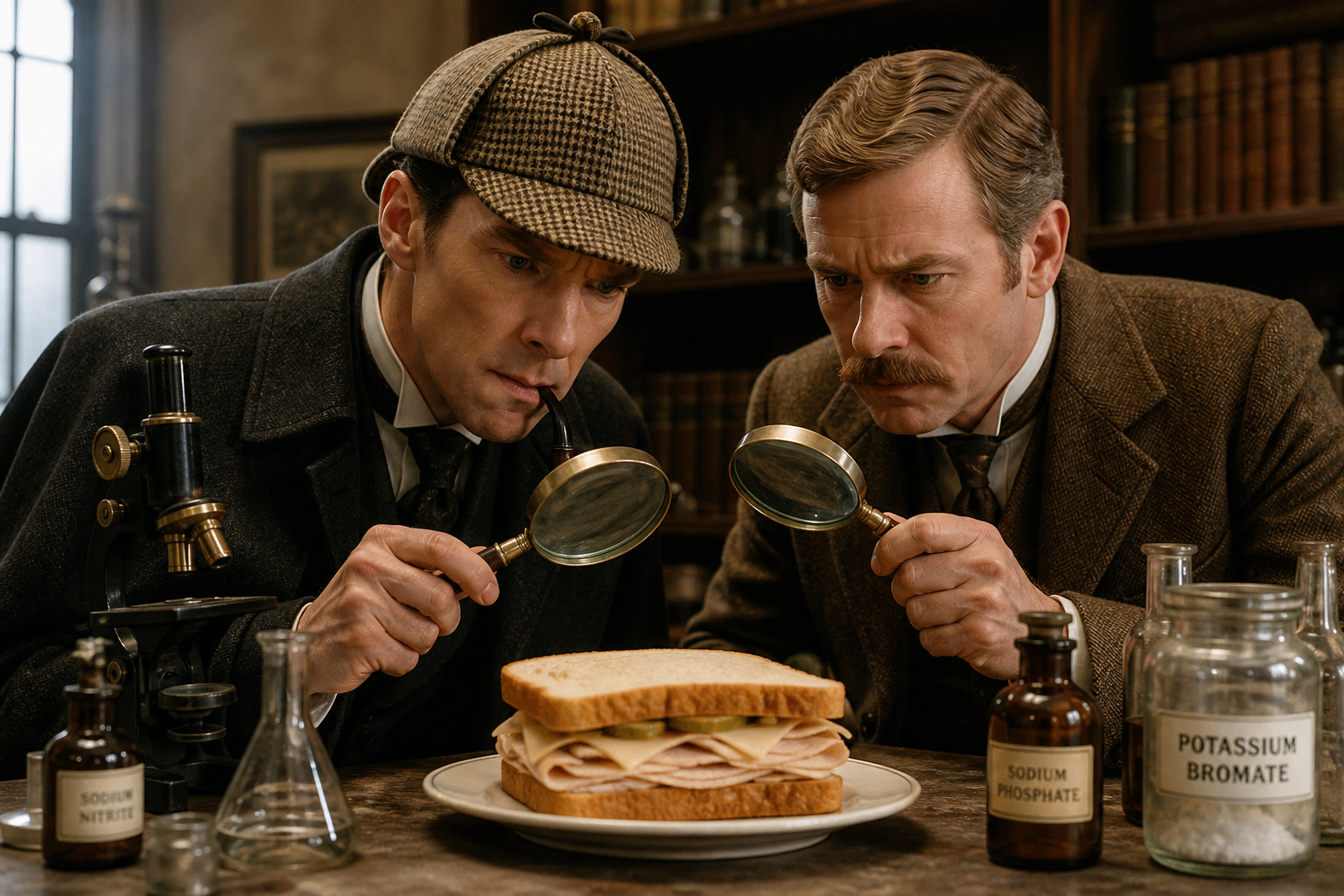
It was in the autumn of eighteen-ninety-something — the precise year I shall leave indeterminate, for reasons that will become apparent — that my friend Mr. Sherlock Holmes received the most singular commission of his remarkable career. It concerned not a murder, nor a theft, nor any of the conventional crimes that had hitherto furnished his extraordinary intellect with its necessary exercise. It concerned, of all things, a sandwich.
I had called upon Holmes that morning to find him in his customary attitude of intense contemplation — that is to say, slumped in his armchair in a dressing gown of dubious provenance, staring at the ceiling with an expression suggesting that the ceiling had said something offensive. The room reeked pleasantly of pipe tobacco and less pleasantly of whatever chemical compound he had been burning in his spirit lamp the evening prior.
“Watson,” said he, without so much as glancing in my direction, “you are troubled.”
“I am nothing of the sort,” I replied, somewhat nettled, for I had taken particular care that morning to compose my features into an expression of cheerful equanimity.
“Your stride,” said Holmes, “carries a particular heaviness in the right heel that you develop only when you have been walking the hospital wards and have seen something that disturbs your medical conscience. You have your coat on inside out, which indicates haste and distraction. And you have jam on your left cuff from a breakfast you did not finish, which for you is unprecedented. Something has unsettled you, my dear fellow. Tell me about the patient.”
I stared at him. I have never ceased to be astonished by these small miracles, though I have witnessed hundreds of them.
“She is twenty-four years old,” I said, sitting heavily in the basket chair opposite. “A heart attack. She will be on medications for the rest of her life.”
“Smokes?”
“No.”
“Family history?”
“None of significance.”
“Then something in the diet,” said Holmes, immediately. “Tell me what she ate.”
Part the First: In Which Inspector Lestrade Arrives With a Theory
Before I could answer, there came the sound of heavy footsteps upon the stair — the particular tread, I had long since learned, of official competence ascending in a state of comfortable self-satisfaction. The door opened to admit Inspector Lestrade of Scotland Yard, his ferret features arranged in an expression of professional certainty that I had come to regard with deep and affectionate suspicion.
“Mr. Holmes,” said he, settling himself into a chair without being invited, in the manner of a man who has solved enough problems to feel at home anywhere. “I have cracked it.”
“Have you,” said Holmes, without inflection.
“The dietary question,” said Lestrade, producing a sheaf of papers with the flourish of a conjurer. “Simple enough, once you apply the proper scientific method. The body is an engine. Food is the fuel. The question of health is therefore a question of thermodynamic accounting.” He laid the papers on the table. They were covered in columns of numbers. “Four calories per gram of protein. Four calories per gram of carbohydrate. Nine calories per gram of fat. I have it from Atwater himself — brilliant man, trained at Yale, built a copper chamber large enough to live in. Measured everything. Every breath. Every movement. The arithmetic is unimpeachable.”
“The arithmetic,” said Holmes, “is not in question.”
“Then we are agreed,” said Lestrade, beaming.
“We are not agreed,” said Holmes. “We have not yet established what question the arithmetic is answering.”
Lestrade blinked. “Why — how much energy a food provides. What the body burns.”
“And if two foods provide identical energy,” said Holmes, with the dangerous patience of a man who can see precisely where the argument will fail, “you would predict identical physiological outcomes?”
“Naturally.”
“Then,” said Holmes, “kindly explain to me why populations across four continents are simultaneously developing obesity and type 2 diabetes at rates no caloric model predicted, despite decades of public messaging about energy balance. Explain why patients in controlled wards, receiving identical caloric prescriptions, produce wildly different outcomes. Explain why your arithmetic, impeccable as it is, has failed to reverse an epidemic it was designed to prevent.” He turned back to the ceiling. “The calorie, Lestrade, is not wrong. It is merely answering a question that is no longer relevant.”
Lestrade gathered his papers with the dignity of a man accustomed to being underestimated by people he considers eccentric. “I shall leave you to your theorizing, Mr. Holmes,” said he. “Some of us have practical work to do.”
“Some of you do,” said Holmes, agreeably.
After Lestrade had departed, I ventured, “He is not entirely wrong, Holmes. Calories do matter.”
“Of course they matter,” said Holmes, somewhat sharply. “So does the phase of the moon, in its effects upon tidal patterns. The question is not whether a factor is real. The question is whether it is sufficient for the question at hand. Lestrade is a perfectly competent man within the limits of his method. However, the limits of his method are precisely the problem. He reasons deductively, Watson. From fixed premises to entailed conclusions. No new observation can alter his arithmetic, which means no new observation can teach him anything his arithmetic does not already know.” He tapped his pipe against his knee. “It is reasoning within a locked room. Useful when the room contains everything relevant to the problem. Catastrophic when it does not.”
Part the Second: In Which Inspector Gregson Arrives With a More Elaborate Theory
The second visitor arrived the following morning, and he was, if anything, more confident than the first. Inspector Tobias Gregson was a tall, fair man who had always regarded himself as the intellectual superior of his colleagues, and on this occasion, he arrived bearing not a sheaf of papers but an entire portfolio, from which he extracted charts, diagrams, and several monographs published in journals of considerable respectability.
“The nutrient,” said Gregson, arranging his materials on Holmes’s desk with systematic precision, “is the key. Not merely energy, it is the specific biochemical compounds that are the answer. Beriberi is a thiamine deficiency. Pellagra is a niacin deficiency. Rickets is a vitamin D deficiency. In each case, simply identify the missing compound, restore it, and eliminate the disease.” He spread his hands in the gesture of a man presenting an irrefutable case. “The method works. It has saved millions of lives. We can now apply the same logic to all dietary questions: identify the relevant nutrient, measure its presence or absence, and predict the outcome with certainty.”
“And it has worked,” observed Holmes.
Gregson looked slightly surprised to be agreed with. “Precisely. Beriberi eliminated. Pellagra eradicated. These vitamin discoveries represent —”
“Genuine triumphs of inductive reasoning,” exclaimed Holmes, rising slightly from his chair. “Quite right. The Japanese naval surgeon Takaki observed a pattern, formed a hypothesis, changed the diet, and watched the disease disappear — before anyone understood the mechanism. Eijkman fed chickens polished rice, observed the paralysis, fed them rice bran, observed the recovery, and constructed the best available explanation from the available evidence. They attended to the anomaly. They followed the evidence wherever it led.” He paused and fired a shot across the Inspector’s bow, “And then?”
Gregson frowned slightly and, after a brief pause, offered, “And then the field was established. The method was confirmed.”
“The method was confirmed for deficiency diseases,” corrected Holmes. “A specific kind of problem, with a specific kind of cause, amenable to a specific kind of solution. And what did you and your colleagues do following that confirmation?”
“We applied it —”
“You elevated it,” interjected Holmes. “From a useful tool into a universal template. You shifted, Gregson, from induction to deduction. From asking ‘what does the evidence suggest about this food?’ to ‘what do our premises forecast about this food?’ You extrapolated: if a lack of thiamine causes beriberi, then perhaps a lack of fiber causes colon cancer. If saturated fat raises cholesterol in a laboratory setting, then dietary saturated fat must cause heart attacks in populations. Fixed premises. Necessitated conclusions.” He rose from his chair and moved to the window, looking down at Baker Street below. “You have looked at the world and seen only what your narrow perspectives permitted you to see. When the evidence contradicted your conclusion, you blamed the evidence.”
“I hardly think —”
“The Women’s Health Initiative,” said Holmes, without turning from the window. “One of the largest dietary intervention trials ever conducted. A low-fat diet did not significantly reduce the risk of cardiovascular disease or cancer. Your beta-carotene supplementation trials were stopped early when preliminary data suggested the supplements might be making lung cancer worse in smokers.” He turned and addressed Gregson as a parent might a persistent, nagging child, “Every one of those anomalies was treated as a measurement problem, a compliance failure, or an unfortunate exception. The framework could not be wrong. Only the data could be wrong. Is that not so?”
Gregson was quiet for a moment. “Nutritionism has accomplished a great deal.”
“It has,” said Holmes, not unkindly. “I do not dispute it. I merely observe that it has reached the boundary of what it can accomplish, and that recognizing a boundary is not the same as admitting defeat. It is, rather, the beginning of wisdom.” He returned to his chair. “You may leave your monographs, Gregson. I shall read them with interest.”
After the inspector had gone, I said: “You were somewhat gentler with him than with Lestrade.”
“Gregson began correctly,” said Holmes. “He merely stopped too soon. He had the right method, applied it to the right problem, and obtained the right answer. The error was in assuming that because the method answered one class of questions, it must answer all questions. It is a very common error, Watson. The danger of early success is that it ends the exploration short of the ultimate prize.”
[Continue to explore the mystery of The Vanishing Vitality with Sherlock and Dr. Watson next week with installment the second.]