Being an Account of the Most Peculiar Case Ever Brought to 221B Baker Street
As recorded by Dr. John H. Watson, M.D. (installment the second)
Part the Third: In Which Holmes Examines the Hospital Tray
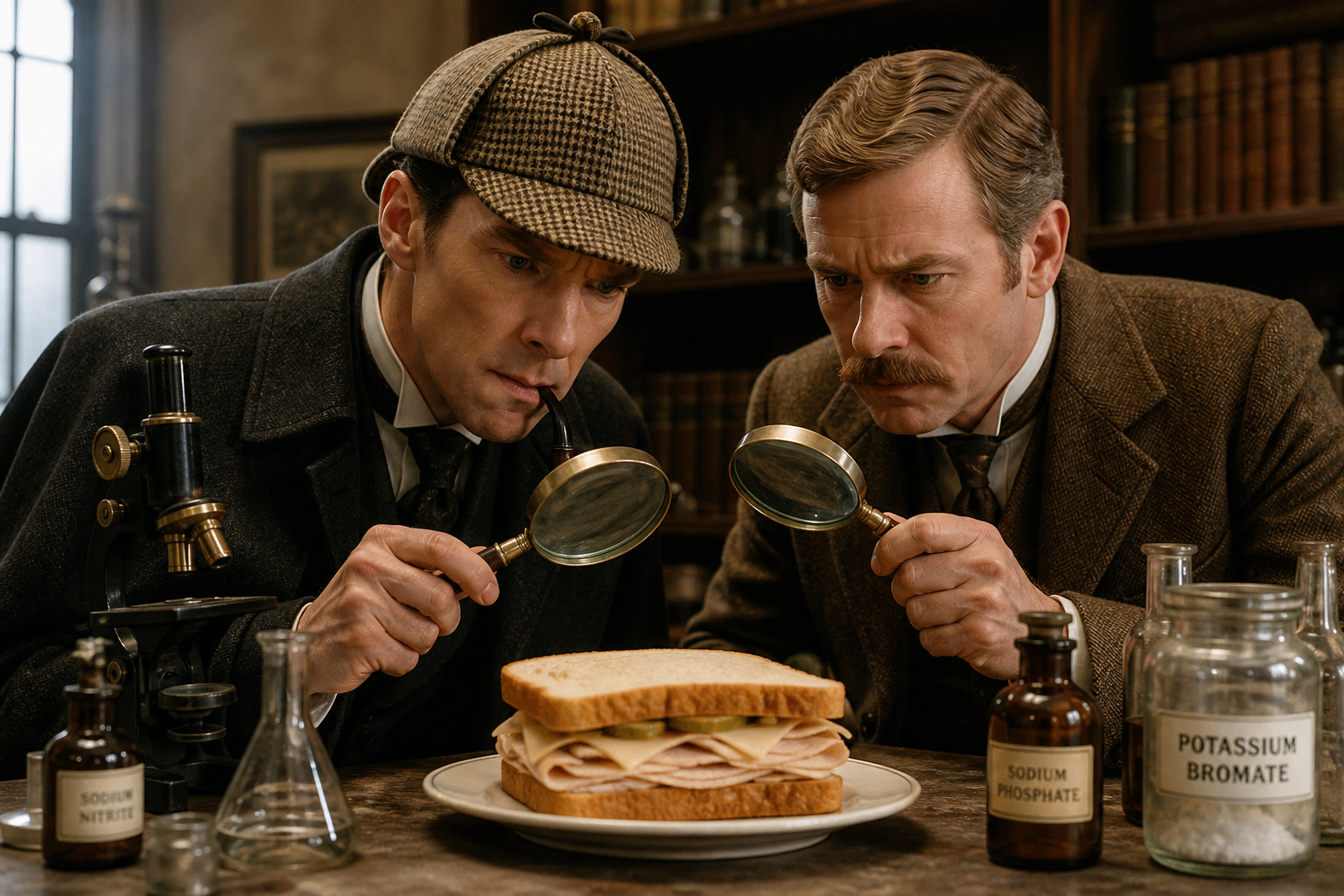
I described the tray to Holmes in as much detail as I could recall. The deli turkey on its commercial white bread. The cheese-like substance of an orange so vivid it appeared almost to glow in the darkness. The green gelatin of uncertain origin. The pseudo-salad of iceberg lettuce and cherry tomatoes of adamantine hardness, dressed in an emulsion of extracted vegetable oils bearing the label of a company whose name suggested wholesomeness without particularly delivering it.
Holmes listened without expression. When I finished, he was silent for a long moment.
“Lestrade’s analysis,” he said at last.
“I beg your pardon?”
“Apply Lestrade’s method to that tray. Protein, present. Carbohydrates, present. Fat, present. Fiber, minimal but present. Calories, within the acceptable range. Sodium, elevated but defensible. Conclusion: a nutritionally adequate hospital meal.”
He looked at me. “And now Gregson’s method. Thiamine present. Niacin present. The major nutrients accounted for. No obvious deficiency. Conclusion: the patient’s dietary needs are being met.”
He rose and began to pace, which was always a sign that he was working. “Now tell me, Watson, as a physician: are that patient’s dietary needs being met?”
I thought of the tray. Of the young woman who had eaten food like that her entire life. “No,” I said slowly. “But I could not have told you precisely why, not in terms that would satisfy your scientific rigor.”
“Precisely,” said Holmes. “Because the question neither Lestrade nor Gregson knows how to ask is this: what is the most probable account of what this food will do to the biological system that receives it, given everything we know about how such systems function?”
He stopped pacing.
“Look at that bread, Watson. The food matrix has been industrially refined — the physical architecture through which nature packages its nutrients has been disrupted. The turkey is not turkey in any meaningful sense; it is a reconstituted product containing additives not found in a bird simply roasted. The orange substance is not cheese; it is an industrial formulation designed to simulate the sensory experience of cheese while bearing no structural resemblance to it. The gelatin contains colorings and sweeteners synthesized in a laboratory. The dressing is an emulsion of cheap vegetable oils stabilized by compounds that have existed for less time than most of the people consuming them.”
“The food matrix,” I said, recalling something I had read.
“Precisely. The intricate physical architecture through which nature packages nutrients. Not merely what a food contains, Watson, but how it is structured — how rapidly it releases what it contains, what signals it sends to the gut, how the gut signals to the brain, how the microbiome processes what arrives.
When you eat a properly constructed meal — your own turkey sandwich, let us say, from a bird actually roasted, on bread actually fermented — the sensory cues and the metabolic reality are coherent. The smell promises what the physiology delivers. The body has been doing business with food of that kind for a very long time and knows how to read the signal.”
“And the hospital tray?”
“Is sending signals,” said Holmes, “that the regulatory system cannot coherently interpret. The sensory cues have been engineered to promise one thing. The metabolic delivery provides something structurally different. The anticipatory responses that real food initiates — the hormonal cascades, the enzymatic preparations, the neurological readiness — are triggered by signals that do not accurately predict what is about to arrive.” He sat. “Prediction errors accumulate. Regulatory strain increases. Do this for twenty-four years, and you should not be surprised to find a young woman in the cardiac ward.”
“Good Lord!” I said.
“It is not mysterious,” said Holmes. “It merely requires asking the right question.”
Part the Fourth: The Adventure of the Dog That Did Not Bark
“But how do you demonstrate it?” I asked. “Lestrade will tell you the calories are adequate. Gregson will tell you the proper nutrients are present. You cannot simply assert that the food matrix was disrupted.”
Holmes smiled — a thin, precise smile that I had learned to associate with the moment before he revealed something that would seem, in retrospect, to have been obvious all along.
“You recall Silver Blaze,” said he.
“The horse. The racing stable.”
I should perhaps pause here to explain the matter of Silver Blaze, for not every reader will have followed that singular affair as closely as I. It concerned a celebrated racehorse, the favourite for the Wessex Cup, who vanished from a well-guarded stable on the eve of the race, leaving behind a dead trainer and a set of clues that had entirely defeated the official investigators.
Holmes had resolved to solve the case, as he so often did, by attending to something everyone else had overlooked — not a clue that was present, but one that was absent. A watchdog had been kenneled near the stable that night. It had not barked. And that silence, Holmes had observed with his characteristic precision, was the most eloquent thing in the entire case: no stranger had entered that stable, for a stranger would have set the dog barking. The evidence was the absence of evidence, and the absence told him everything.
Holmes continued, “The curious incident of the dog in the night-time. The inspector pointed out that the dog had done nothing. I observed that this was precisely the curious incident. The anomaly was not an absence of evidence. The anomaly was the evidence.” He leaned forward. “A team of investigators at the American National Institutes of Health constructed two diets with extraordinary precision. Identical calories. Identical macronutrients. Identical sugar. Identical fiber. Identical sodium. By every metric that Lestrade and Gregson consider relevant, the two diets were equivalent. The premises were equal. The conclusions should have been equal.”
“And were they not?”
“The participants consuming the ultraprocessed diet ate an average of five hundred additional calories per day. Spontaneously. Without instruction. They ate faster. They gained weight. The participants consuming the minimally processed diet spontaneously reduced their intake and lost weight.” Holmes opened his hands. “The premises were identical. The conclusions were not. In a deductive framework, this is impossible. In an inductive framework, it is the most informative result conceivable. Recall, my dear Watson, that when we have ruled out the impossible, whatever shall remain, however improbable, must be fact!”
I sat back in my chair. “The dog that did not bark.”
“Precisely. The nutrient model predicted that the two diets would produce identical outcomes. They did not. This is not an anomaly to be explained away. It is the curious incident that breaks the case. It tells us, with some precision, that something in the food — something invisible to the caloric and nutrient-centric frameworks — is determining how much participants eat and how their bodies respond.” He paused. “The question is what.”
“And you know what it is.”
“I know what class of thing it is,” said Holmes. “It is structural. It is informational. It is the difference between a dietary signal that the regulatory system can coherently read and one that it cannot. The ultraprocessed foods speak, Watson, in a language that biological systems cannot comprehend. It is Jabberwocky conversation for dinner, and the consequences are precisely what we observe.”