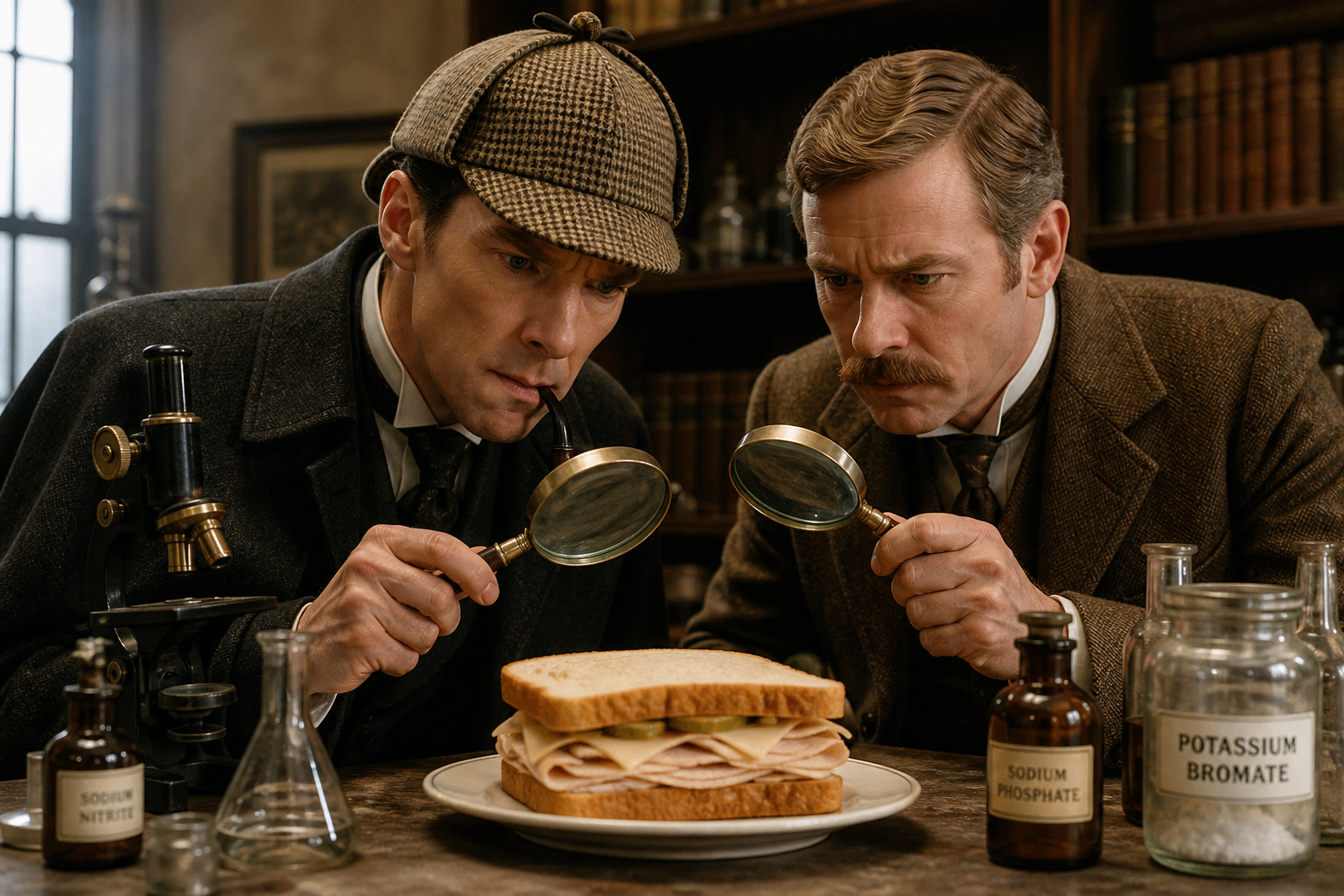
Being an Account of the Most Peculiar Case Ever Brought to 221B Baker Street
As recorded by Dr. John H. Watson, M.D. (Installment being the third and final)
Part the Fifth: Holmes and the Method of Induction
“Then what you are proposing,” I said carefully, “is that food should be understood not as fuel — not even as a collection of nutrients — but as information?”
“I am proposing,” said Holmes, “that this is what it has always been, and that the organisms consuming it have always treated it as such. We are the last to notice.” He reached for his pipe. “Consider what biological systems actually do when they encounter food. They do not wait for nutrients to arrive and then react. They anticipate. The smell of a meal initiates hormonal responses before a single gram of food has crossed the stomach. The texture of food on the tongue triggers enzymatic secretions calibrated to what the texture predicts about the food’s composition.
The body is running a generative model — a continuous, probabilistic forecast of what it is about to receive, based on everything it has learned from prior experience. When the forecast is accurate, when the sensory signal means what it appears to mean, regulation proceeds efficiently. When the forecast is violated — when engineered sensory complexity promises a metabolic reality that degraded food matrices cannot deliver — the system must expend effort to compensate.”
“It is rather like,” I began, and then stopped.
“Yes?” said Holmes, with what I can only describe as alert patience.
“It is rather like what you do,” I said. “When you walk into a room, you do not wait for someone to tell you what happened. You observe. You construct the most probable account from the available evidence. You are always running a model of what the evidence is likely to mean, and you revise it as new evidence arrives.”
Holmes was quiet for a long moment. Then, to my considerable surprise, he laughed — a genuine laugh, not the mirthless bark I was accustomed to.
“Watson,” said he, “you have just described the essential architecture of inductive reasoning more elegantly than I have managed in three attempts at a monograph on the subject.” He settled into his chair. “Yes. Precisely. I do not begin with premises. I begin with evidence. My conclusions are always the best available hypothesis, never a logical necessity. I am perpetually open to revision.
A new observation is never an inconvenience; it is, potentially, the most important datum in the room. This is induction, Watson — the method I have always used, despite what I am reputed to call it.” He paused. “And it is the method that any serious account of food and health must eventually adopt.”
“Then Nutritionism,” I said, “was doing the opposite.”
“It began correctly,” Holmes said gently. “The vitamin detectives were genuine inductivists. Takaki, Eijkman, and Funk — they observed, they hypothesized, they revised. It was only when the victories accumulated that the method hardened into dogma. Success is the enemy of inquiry, Watson.
Once you have solved enough problems with a single tool, you begin to imagine the tool is universal. You stop asking what the evidence suggests and start asking what your premises entail.”
He shook his head. “Fixed commandments. Irrevocable sin. The case is closed before the investigation has properly begun. I should not tolerate it for five minutes.”
Part the Sixth: Elementary, My Dear Watson
“Then how would you advise the professionals to proceed?” I asked.
Holmes rose and moved once more to the window, looking out over Baker Street with the expression of a sailor searching for shoreline.
“The caloric framework was the first investigator on the scene — well-intentioned, precise within its scope, genuinely useful for the problem it was designed to address. But once the relevant question shifted from how much food to what kind of food, it had nothing further to contribute. It could count. It could not explain.”
“Lestrade,” I said.
“If you like. The second investigator arrived with better tools. Genuine achievements. But the triumphs convinced it that its deductive method was infallible, and so it applied fixed premises to a world that would not cooperate with them. When the evidence contradicted the premises, it blamed the evidence.”
“Gregson.”
“And now,” said Holmes, turning from the window, “the case requires a third investigator. One who does not begin with premises. One who inherits everything the prior investigators discovered — the metabolic significance of energy, the biological necessity of specific nutrients — without inheriting their assumption that these things are sufficient in and of themselves. One who asks, rather, what problem the organism is actually solving when it encounters food. And whether the dietary environment it finds itself in supports that solution.”
He settled back into his chair.
“Such a solution updates beliefs continuously as new evidence accumulates. Every meal is a clue. Every biological response is evidence. Every departure from predicted outcomes is a curious incident worth attending to. The case is never closed.” He picked up his pipe. “Watson, you asked how I knew you had been in the hospital wards.”
“You told me. The heel, the coat, the jam.”
“I told you the evidence. I did not tell you that I had reasoned from fixed premises about what evidence is possible in what circumstances. I told you what I observed, and I told you the most probable account of those observations. I could have been wrong. A new observation could have revised the conclusion.” He lit his pipe. “This is all I have ever done. And it is all that any honest account of food and health can do. The alternative — deducing from premises fixed before the evidence arrives — is, in the end, just a very elaborate way of not looking.”
He drew on his pipe.
“Elementary, my dear Watson,” said he. “Quite elementary.”
It remains only to record that the young woman of twenty-four left the hospital and, under the guidance of a physician who had thought carefully about what she ate rather than merely how many calories she consumed, made a recovery that exceeded all initial prognosis. The hospital, I am glad to report, subsequently reconsidered its tray.
The calorie persists, as it must, for it captures something real. Nutritionism persists, as it must, for its discoveries were genuine. But the case, as Holmes would say, required the right question — and the right question, it turned out, had been waiting all along for those with the courage to ask it.
Thus concludes The Case of The Vanishing Vitality, being an Account of the Most Peculiar Case Ever Brought to 221B Baker Street as recorded by Dr. John H. Watson, M.D.