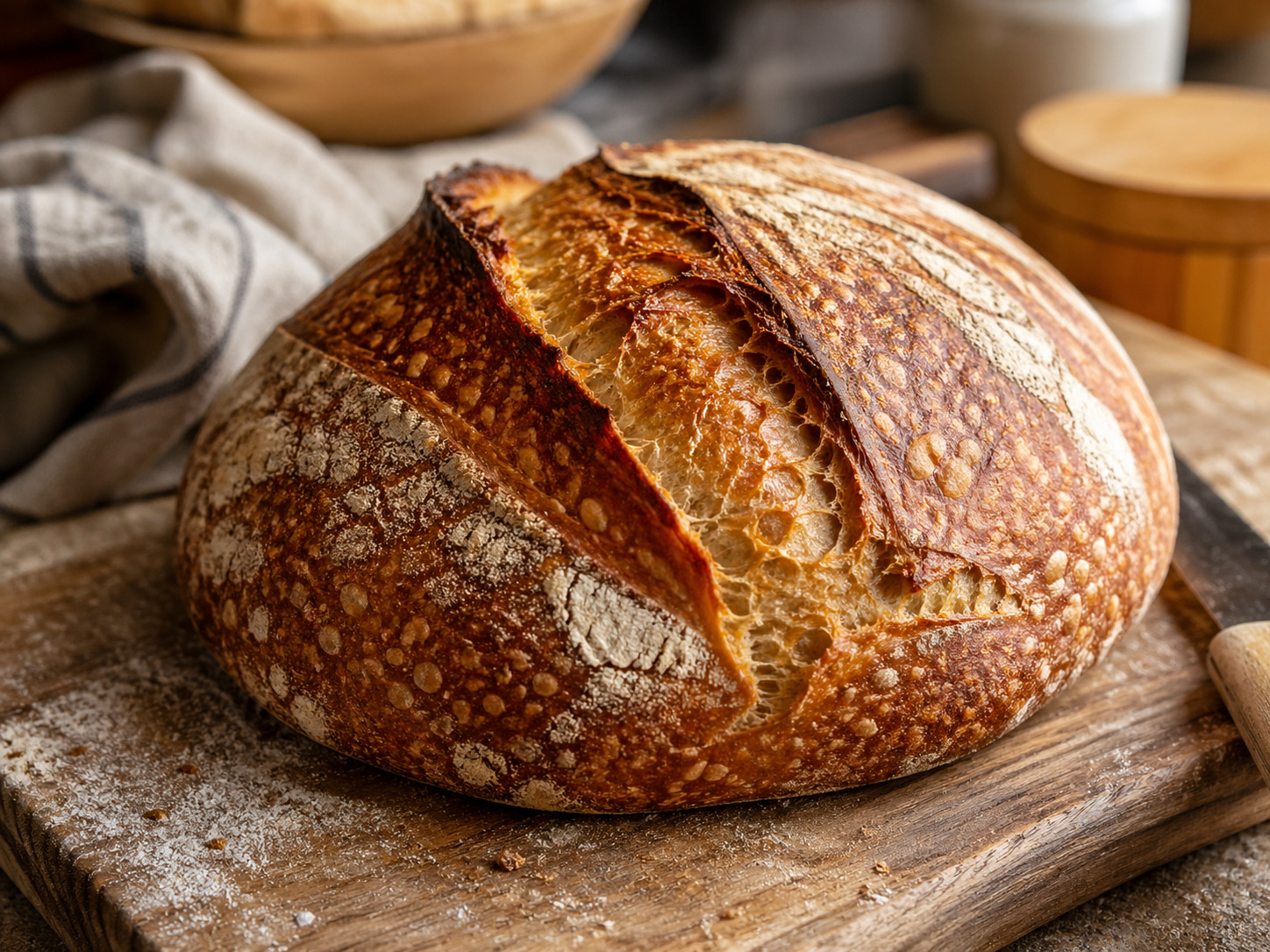
According to Eric Pallant, author of Sourdough Culture: The History of Bread Making from Ancient to Modern Bakers, sourdough bread originated in the Fertile Crescent of the Middle East 6,000 years ago, when it was (and still is) made of four basic ingredients: flour, water, salt, and a starter made from a live fermented culture of wild yeast and bacteria. Nowadays it can be found in local cafes, small-scale microbakeries, farmers markets, and major grocery stores.
In 2024, “gut microbiome” was one of the most commonly googled words and the current global market for fermented foods is booming; but are there really health benefits to be found in this ancient leavened bread?
A Brief History
Up until the invention of commercial yeast around 200 years ago, sourdough was the primary kind of bread. Then came the invention of commercial yeast during the Industrial Revolution and the consequent rise in popularity of the mass-produced yeast bread that we see today.
What’s the Difference?
Sourdough is made using a cultured starter which includes wild yeasts and lactic acid bacteria, and the bread dough is usually fermented for one to two days (Suo, 2021). While bread made with active dry yeast rises and is ready to bake in just a few hours. According to a study by Åse Hansen and Birgit Hansen published in European Food Research and Ecology in 1996, sourdough bread can increase the “quality, texture, elasticity, palatability, and aroma of bread.” So, not only are the processes of making the two breads different, but they also yield different outcomes.
Is Sourdough Actually Healthier?
Studies show that in addition to improved flavor, sourdough also has numerous health benefits. One study found that sourdough bread has a lower glycemic index, making it less likely to cause a rapid spike in blood sugar levels (Alkay, 2024). Other benefits found in the study show that sourdough bread includes high levels of postbiotics, antioxidants, beneficial microbes, and dietary fiber for the gut. It also helps with the absorption of minerals and shows higher levels of nutrients such as B vitamins and vitamin K (Schwartz, 2020).
Another potential benefit, according to Dr. Erin McKenney, is the improved digestibility of sourdough for some people who are usually gluten intolerant (not including those with celiac disease).
Bleached and Bromated Flour
Although research shows that sourdough bread is better for both our health and our taste buds, not all flour is created equal. One concern with flour is that it’s commonly bleached with chlorine gas, benzoyl peroxide, or potassium bromate for visual appeal and baking quality. However, some countries have enacted bans on certain bleaching agents. For example, potassium bromate has been linked to kidney damage and cancer in animal studies and is banned in the European Union, Canada, and Brazil and chlorine gas has been banned in the United Kingdom and the EU.
Benzoyl Peroxide (BPO) is the most commonly used bleaching agent in the U.S. and has been shown to degrade nutrients and vitamins in the flour, induce oxidative stress in the body, adversely affect liver health, and potentially act as a tumor promoter. If purchasing flour, look out for “bleached flour” and “potassium bromate” in the ingredients list and try to opt for unbleached and non-bromated flour.
Are Some Sourdough Breads Better Than Others?
Currently in the U.S., there is no regulation that protects traditional sourdough, and so bread in the supermarket that’s sourdough may not be of the same quality as the bread made at home or by your local sourdough bakery. The good news is that nowadays, more and more local sourdough bakeries are popping up and many states allow for home microbakeries, so it’s becoming increasingly easy to find locally made sourdough.
Making Your Own
If you don’t live in an area where sourdough bread is readily available, there is another option. You can make it in the comfort of your own home, which allows you to control the ingredients that go into it. In fact, during the peak of COVID-19, because many people were spending more time at home, baking was used as a leisure activity, a stress-reducer, and a way to become more self-sufficient during uncertain times. There are numerous resources for instructions on baking sourdough bread including youtube tutorials, online blogs, recipe books, and even in-person classes.
Final Thoughts
Sourdough can be a healthier and tastier alternative to other yeast breads, and its increased accessibility plus the numerous sourdough baking resources available are making it much more readily available. Just be sure to look out for bleached and bromated flour and make sure that the bread you’re buying is the real thing.
Sources
Alkay, Z., Falah, F., Cankurt, H., & Dertli, E. (2024). Exploring the Nutritional Impact of Sourdough Fermentation: Its Mechanisms and Functional Potential. Foods, 13. https://doi.org/10.3390/foods13111732.
Hansen, Å., Hansen, B. Flavour of sourdough wheat bread crumb. Z Lebensm Unters Forch 202, 244–249 (1996). https://doi.org/10.1007/BF01263548.
Hou, L., Li, S., Ou, Y., & Zhu, L. (2025). Flour bleaching: over a century of health risks and controversies. Food, Nutrition and Health, 2. https://doi.org/10.1007/s44403-025-00028-x.
Islam, M., & Islam, S. (2024). Sourdough Bread Quality: Facts and Factors. Foods, 13. https://doi.org/10.3390/foods13132132.
McKenney, E. (2021). Webinar: Sourdough bootcamp [Video]. YouTube. https://www.youtube.com/watch?v=o7vqYLEOAMM.
Pallant, E. (2020). A Brief History of Sourdough. In Fermentology. NC State University Libraries. https://doi.org/10.52750/875292
Pérez-Alvarado, O., Zepeda-Hernández, A., Garcia-Amezquita, L., Requena, T., Vinderola, G., & García-Cayuela, T. (2022). Role of lactic acid bacteria and yeasts in sourdough fermentation during breadmaking: Evaluation of postbiotic-like components and health benefits. Frontiers in Microbiology, 13. https://doi.org/10.3389/fmicb.2022.969460.
Pontonio, E., Di Cagno, R., Mahony, J., Lanera, A., De Angelis, M., Van Sinderen, D., & Gobbetti, M. (2017). Sourdough authentication: quantitative PCR to detect the lactic acid bacterial microbiota in breads. Scientific Reports, 7. https://doi.org/10.1038/s41598-017-00549-2.
Schwartz, R. (2020, July 13). What are the health benefits of sourdough versus yeast? Rosie Schwartz. https://rosieschwartz.com/2020/07/13/what-are-the-health-benefits-of-sourdough-versus-yeast/
Sofo, A., Galluzzi, A., & Zito, F. (2021). A Modest Suggestion: Baking Using Sourdough – a Sustainable, Slow-Paced, Traditional and Beneficial Remedy against Stress during the Covid-19 Lockdown. Human Ecology, 49, 99 – 105. https://doi.org/10.1007/s10745-021-00219-y.
Suo, B., Chen, X., & Wang, Y. (2021). Recent research advances of lactic acid bacteria in sourdough: origin, diversity, and function. Current opinion in food science, 37, 66-75. https://doi.org/10.1016/j.cofs.2020.09.007.
Voidarou, C., Antoniadou, M., Rozos, G., Tzora, A., Skoufos, I., Varzakas, T., Lagiou, A., & Bezirtzoglou, E. (2020). Fermentative foods: Microbiology, biochemistry, potential human health benefits and public health issues. Foods. https://doi.org/10.3390/foods10010069
Wall, C. (2025). Gut Health: Translating diet and gut microbiota research into practice.. Proceedings of the Nutrition Society, 84. https://doi.org/10.1017/s002966512510013x.