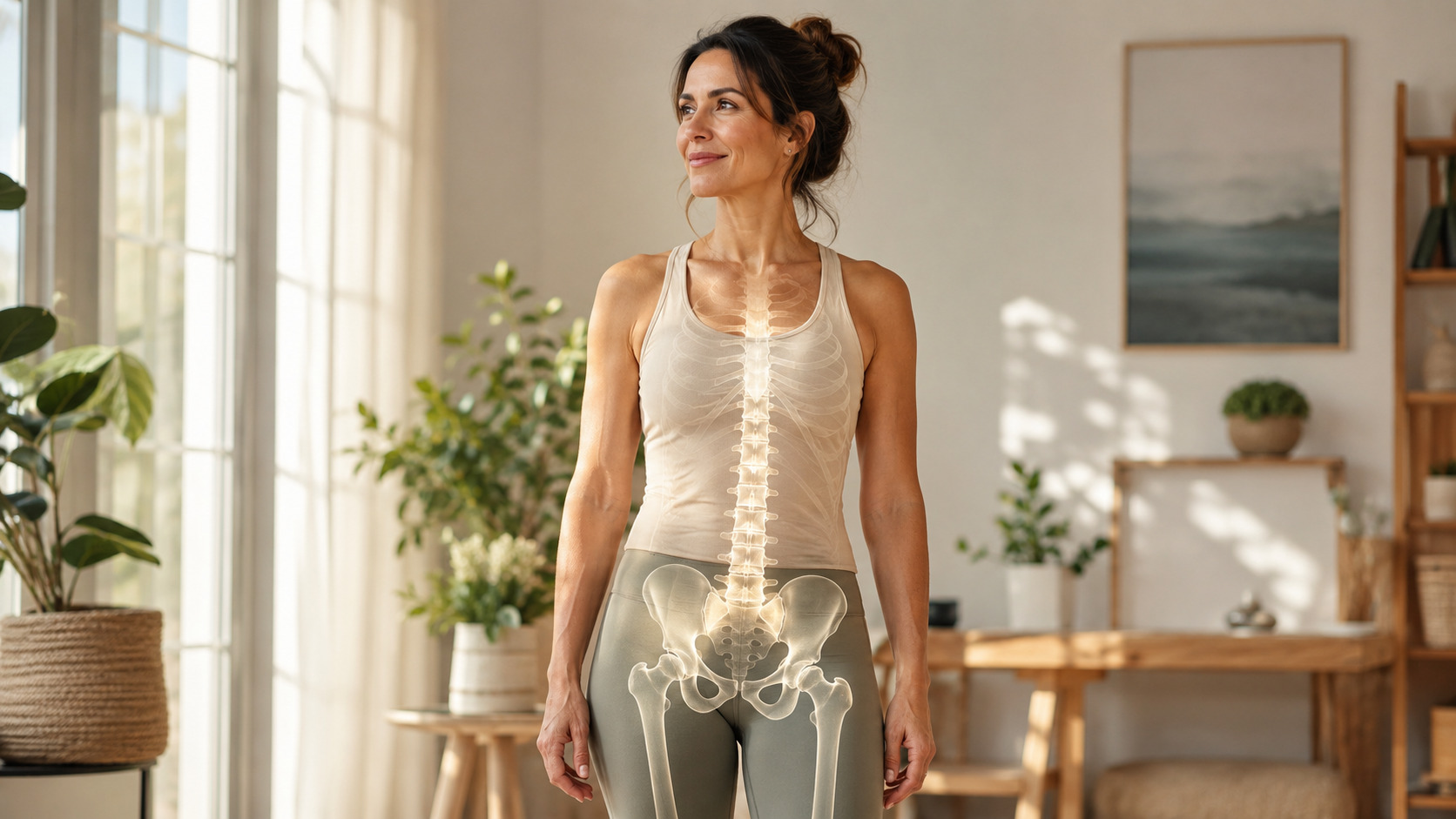
When women enter menopause, they are told to increase their calcium and follow a strict exercise and nutritional regimen to help maintain their bone health. But why?
Estrogen, the primary female reproductive hormone, is a vital ingredient to regulating your bone tissue. Therefore, when it starts to decline during menopause as their estrogen levels decrease , women encounter a higher risk of developing conditions including osteoporosis.
Osteoporosis is typically defined as your bone tissue becoming fragile and more susceptible to the risk of fractures.
According to the Endocrine Society, “1 in 10 women over the age of 60 are affected by osteoporosis worldwide”. Furthermore, Osteoporosis Canada, reports about 80 percent of people living with osteoporosis are women, and that 22 percent of women who experience a hip fracture as a result of osteoporosis “will die within the following year”.
The good news? Building healthy bone habits early can help protect your future self from osteoporosis before menopause even begins.
How does bone health work?
Think about bone as a living tissue that is constantly being broken down and rebuilt. Cells called Osteoclasts break down old bone structures and osteoblasts help build new tissue. Because estrogen acts to maintain bone density by inhibiting the breakdown of bone (resorption) and promoting the growth of new bone, a drop in estrogen levels during menopause can accelerate bone loss.
Puberty, Growth, and Hormones
A study by Alana Serota and Giavanna D’Erasmo published in the Journal of Pediatric Orthopaedic Society of North America in 2024 brilliantly stated that “osteoporosis is a pediatric disease with adult consequences.”
Bone density for women and girls is both a nutritional and reproductive health issue. During puberty, estradiol, the most potent and abundant form of natural estrogen, plays a key role in helping to build bone density. At the same time, adequate nutrition supports normal levels of estrogen production. When nutrition and energy production in the body are low, the hormonal system can be disrupted, leading to lower estrogen levels that negatively affect bone mass development. In their study, Serota and D’Erasmo noted that adolescent girls with anorexia nervosa (AN), and thus inadequate nutrition, encountered lower levels of estradiol and, therefore, a higher risk of low bone mass during these critical bone formation years.
This lack of proper nutrition and care for bone health in the early development of a woman’s life can result in prolonged effects on her health, even decades later. But because women’s bone density keeps developing into adulthood, all hope is not lost!
A study by Juan Lu and colleagues published in the Journal of Clinical Densitometry in 2016 found that women reached peak total bone mineral density and content around ages 22 to 25. Other research, including the Canadian Multicentre Osteoporosis Study, shows that peak bone mass can vary depending on the bone site. For example, peak bone mineral density at the hip may occur earlier, while the lumbar spine may not peak until a woman is in her 30s.
The early signs of menopause can typically begin to appear when a woman reaches her forties. So, until then, there’s still time to build-up your bone density bank and avoid conditions such as osteoporosis later in life.
What should women be eating to ensure their bone density is healthy?
In 2016, Weaver et al., published a scientific statement for the National Osteoporosis Foundation that evaluated how different nutrients and lifestyle factors support adult bone health. In their ranking, Calcium received the strongest grade at an ‘A’, followed by Vitamin D, Dairy, and physical activity.
Their full table of rankings can be found here:
Good calcium sources include:
- Dairy, including yogurt, milk, cheese, or fortified dairy alternatives
- Soy or plant-based beverages
- Some fish, such as salmon or sardines
- Beans and dark leafy greens
The Endocrine Society recommends pre-menopausal women to take 1,000 mg of calcium everyday. If you’re already in menopause, they recommend 1,200 mg of calcium.
Key takeaway: If preventive measures for osteoporosis are most effective before estrogen begins to decline, then bone health needs to become part of women’s health conversations long before our fourth decade. Thus, I ask you to think about bone health as a lifelong commitment to ensuring you live a happier and painless perimenopausal period later on.
References
Ahmed, A., Saleem, M., Saeed, F., Afzaal, M., Imran, A., Akram, S., Hussain, M., Khan, A., & Jbawi, E. (2023). A comprehensive review on the impact of calcium and vitamin D insufficiency and allied metabolic disorders in females. Food Science & Nutrition, 11, 5004 – 5027. https://doi.org/10.1002/fsn3.3519.
Cossio-Bolaños, M., Vidal-Espinoza, R., Fuentes-Lopez, J., De Campos, L., Andruske, C., Urra-Albornoz, C., Vasquez, F., & Gómez-Campos, R. (2022). Reference values for bone density and bone mineral content from 5 to 80 years old in a province of Chile. PeerJ, 10. https://doi.org/10.7717/peerj.13092.
Devarshi, P., Legette, L., Grant, R., & Mitmesser, S. (2021). Total estimated usual nutrient intake and nutrient status biomarkers in women of childbearing age and women of menopausal age. The American Journal of Clinical Nutrition, 113, 1042 – 1052. https://doi.org/10.1093/ajcn/nqaa392.
Endocrine Society. (n.d.). How menopause impacts your health. Hormone Health Network. https://www.endocrine.org/menopausemap/health-impacts/index.html
Felson, D. T., Zhang, Y., Hannan, M. T., Kiel, D. P., Wilson, P., & Anderson, J. J. (1993). The effect of postmenopausal estrogen therapy on bone density in elderly women. The New England Journal of Medicine, 329(16), 1141–1146. https://doi.org/10.1056/NEJM199310143291601
Finkelstein, J., Brockwell, S., Mehta, V., Greendale, G., Sowers, M., Ettinger, B., Lo, J., Johnston, J., Cauley, J., Danielson, M., & Neer, R. (2008). Bone mineral density changes during the menopause transition in a multiethnic cohort of women.. The Journal of clinical endocrinology and metabolism, 93 3, 861-8 . https://doi.org/10.1097/01.ogx.0000325504.51681.10.
Flynn, A. (2003). The role of dietary calcium in bone health. Proceedings of the Nutrition Society, 62, 851 – 858. https://doi.org/10.1079/pns2003301.
Heaney, R., Bilezikian, J., Holick, M., Nieves, J., & Weaver, C. (2006). The role of calcium in peri- and postmenopausal women: 2006 position statement of the North American Menopause Society.. Menopause, 13 6, 862-77; quiz 878-80 .
Henry, Y., Fatayerji, D., & Eastell, R. (2004). Attainment of peak bone mass at the lumbar spine, femoral neck and radius in men and women: relative contributions of bone size and volumetric bone mineral density. Osteoporosis International, 15, 263-273. https://doi.org/10.1007/s00198-003-1542-9.
Larson, N., Neumark-Sztainer, D., Harnack, L., Wall, M., Story, M., & Eisenberg, M. (2009). Calcium and dairy intake: Longitudinal trends during the transition to young adulthood and correlates of calcium intake.. Journal of nutrition education and behavior, 41 4, 254-60 . https://doi.org/10.1016/j.jneb.2008.05.001.
Lu, J., Shin, Y., Yen, M., & Sun, S. (2016). Peak Bone Mass and Patterns of Change in Total Bone Mineral Density and Bone Mineral Contents From Childhood Into Young Adulthood.. Journal of clinical densitometry : the official journal of the International Society for Clinical Densitometry, 19 2, 180-91 . https://doi.org/10.1016/j.jocd.2014.08.001.
Matkovic, V., Jelić, T., Wardlaw, G., Ilich, J., Goel, P., Wright, J., Andon, M., Smith, K., & Heaney, R. (1994). Timing of peak bone mass in Caucasian females and its implication for the prevention of osteoporosis. Inference from a cross-sectional model.. The Journal of clinical investigation, 93 2, 799-808 . https://doi.org/10.1172/jci117034.
Naseri, A., Atighi, F., Keshtkar, A., Talezadeh, P., Bakhshayeshkaram, M., Jeddi, M., Dabbaghmanesh, M., Heydari, S., Asmarian, N., & Dabbaghmanesh, M. (2025). Bone Mineral Accrual From Adolescence Into Young Adulthood and Peak Bone Mass: A Longitudinal Cohort Study. Health Science Reports, 8. https://doi.org/10.1002/hsr2.71411.
National Institute of Arthritis and Musculoskeletal and Skin Diseases. (n.d.). Osteoporosis. National Institutes of Health. https://www.niams.nih.gov/health-topics/osteoporosis
Osteoporosis Canada. (n.d.). What is osteoporosis? https://osteoporosis.ca/what-is-osteoporosis/
Ott, S. (1990). Editorial: Attainment of Peak Bone Mass. The Journal of Clinical Endocrinology and Metabolism, 71. https://doi.org/10.1210/jcem-71-5-1082.
Serota, A., & D’Erasmo, G. (2024). Estrogen exposure and skeletal health: Special populations and considerations. Journal of the Pediatric Orthopaedic Society of North America, 7, Article 100061. https://doi.org/10.1016/j.jposna.2024.100061
Teegarden, D., Proulx, W., Martin, B., Zhao, J., McCabe, G., Lyle, R., Peacock, M., Slemenda, C., Johnston, C., & Weaver, C. (1995). Peak bone mass in young women. Journal of Bone and Mineral Research, 10. https://doi.org/10.1002/jbmr.5650100507.
Weaver, C.M., Gordon, C.M., Janz, K.F. et al. The National Osteoporosis Foundation’s position statement on peak bone mass development and lifestyle factors: a systematic review and implementation recommendations. Osteoporos Int 27, 1281–1386 (2016). https://doi.org/10.1007/s00198-015-3440-3
Weaver, C. (1994). Age related calcium requirements due to changes in absorption and utilization.. The Journal of nutrition, 124 8 Suppl, 1418S-1425S . https://doi.org/10.1093/jn/124.suppl_8.1418s.
Xue, S., Kemal, O., Lu, M., Lix, L., Leslie, W., & Yang, S. (2019). Age at attainment of peak bone mineral density and its associated factors: The National Health and Nutrition Examination Survey 2005-2014.. Bone, 115163 . https://doi.org/10.1016/j.bone.2019.115163.