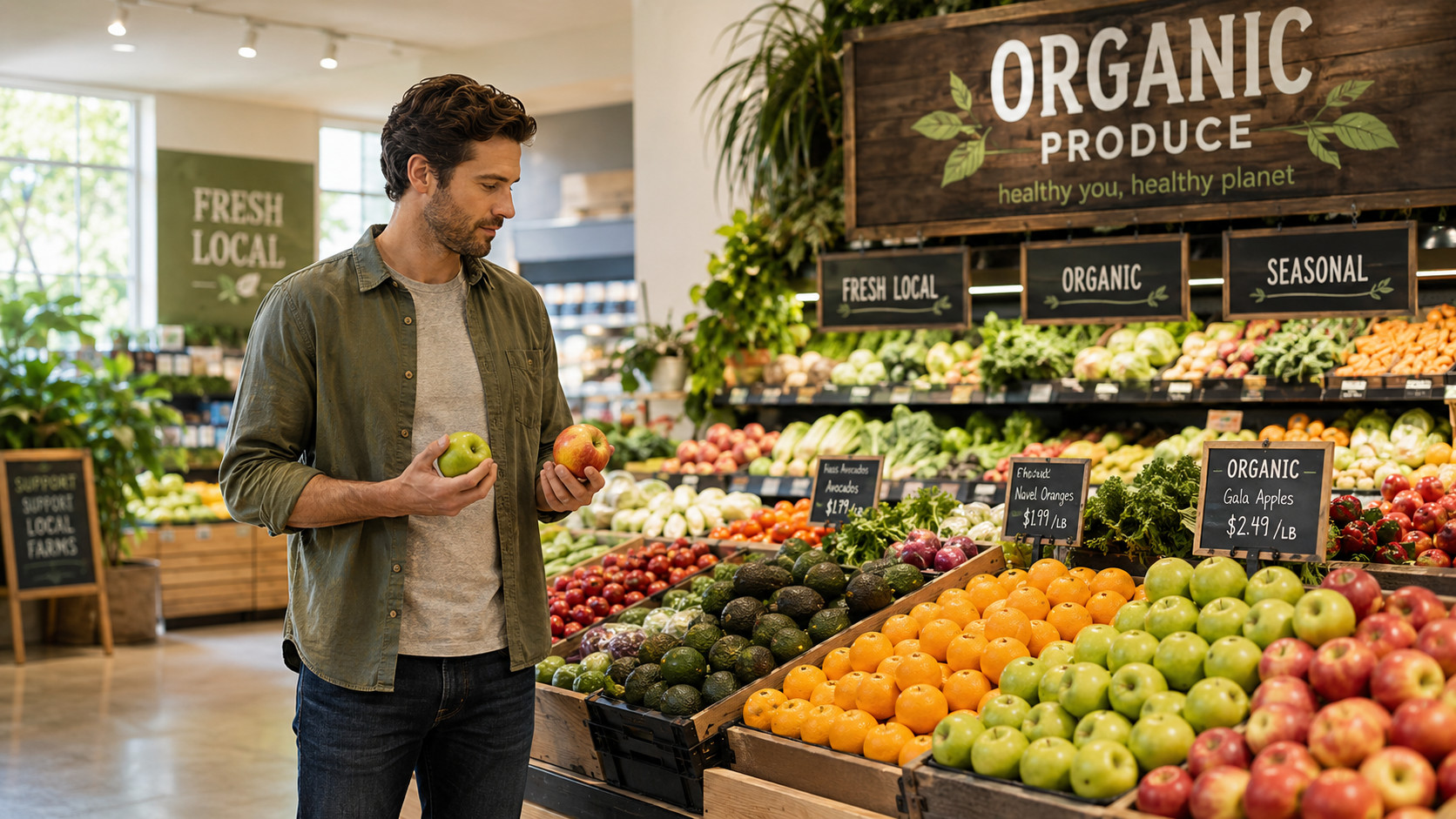
Until relatively recently, humans ate only organic food. However, the Green Revolution of the 1960s brought about many changes in the farming world. New farming methods promised to bring higher yields and more efficiency, to eliminate pests, and to feed a rapidly growing population. Since then, artificial chemicals and fertilizers, growth hormones, and antibiotics have become the new norm for farmers.
Nowadays, two of the major commercial farming methods are either organic or conventional. The goal of the former is to feed the soil, whereas the latter focuses on feeding the plants. When we go grocery shopping, we see numerous certifications that act as marketing tools, but they also serve as a way for shoppers to determine how their food is being fed and grown.
The fact that consumers want more transparency is evident in the substantial growth of the natural foods industry in the past few decades. According to one study, “the U.S. segment of organic-certified foods alone reached $47.9 billion in 2018” (Lang 2021). But, what does the term “certified organic” actually mean, and is it worth switching?
Organic Versus Conventional Farming
“Organic farming is characterized by the prohibition of the use of chemical synthetic fertilizers, pesticides, feed additives and genetically modified organisms and by the application of sustainable agricultural technologies based on ecological principles and natural rules” (Giampieri, 2022).
Some examples of the ways in which organic farms keep their plants and soils healthy and manage pests and diseases include the application of compost and manure, crop rotation, and cover cropping; planting beneficial plants that aren’t meant to be sold but rather used as living mulch. Many farmers and consumers alike feel that growing food organically is an important way to protect the environment, maintain soil fertility and biodiversity, and grow healthy food without pesticide residue (Tscharntke, 2021).
On the flip side, conventional farming is known to produce agricultural runoff that carries chemicals into our waterways, but since the focus is on productivity and output, pollution is often overlooked. In addition, the health of the soil is usually ignored, and synthetic fertilizers, pesticides, and herbicides become necessary to grow fruits, vegetables, and grains successfully. Not only are there environmental concerns about this type of farming, but many people worry that the produce and meat coming from conventional farms might negatively affect the long-term health of those who eat them.
Should We Worry About Pesticides?
A study conducted in Germany shows that “both organic and conventional consumers viewed pesticides, chemicals, and toxins as the greatest threats to food quality and safety” (Koch, 2017). The potential effects on our health from dietary pesticide exposure need further study, but what we currently know is that there are varying levels of pesticide residues present in our food, and we also know that direct pesticide exposure has been linked to health issues such as an increased risk of cancer, adverse birth outcomes, neurological harm, respiratory toxicity, reproductive toxicity, and disrupted hormonal function (Temkin, 2025). Another study cites an epidemiological report suggesting that low pesticide exposure through the diet also poses a risk to human health, especially in children (Sulimanec, 2025).
The United States Department of Agriculture has a database that shows the maximum levels of pesticides and veterinary drugs that are legally allowed in food and agricultural products. You can find this database here. One thing to note is that, although the USDA has found that these are acceptable levels of pesticide residues, we don’t yet know the cumulative toxic effects from exposure to multiple types of pesticides combined.
How to Avoid Pesticides
One way to avoid pesticide residues is to purchase food that is certified organic. The USDA Certified Organic label ensures that your food has been grown on a certified organic farm, free from pesticides and artificial fertilizers. You can learn more about their standards here.
Although it would be ideal to buy everything organic, that’s not always possible based on both availability and affordability. But there are still ways to limit your exposure to pesticide residues even if your food is conventionally grown. The Environmental Working Group (EWG) has put together The Clean Fifteen™ and The Dirty Dozen™ lists which rank produce by the levels of pesticide residues present and is continuously updated based on USDA data. The current Clean Fifteen™ list includes pineapples, sweet corn (fresh and frozen), avocados, papaya, onion, frozen peas, asparagus, cabbage, cauliflower, watermelon, mangoes, bananas, carrots, mushrooms, and kiwi. The Dirty Dozen™ list includes potatoes, pears, blackberries, apples, cherries, peaches, nectarines, grapes, kale, collard greens, mustard greens, and spinach. Consumers can use this list as a resource while grocery shopping and try to prioritize organic when it comes to produce showing high levels of pesticide residues.
The EWG also has a guide on how to wash both organic and conventionally grown fruits and vegetables. Studies show that rinsing in tap water, soaking in tap water, or soaking in baking soda or food-grade vinegar are all viable methods of removing some pesticide residues. For more specific tips, check out the guide here. A study on household procedures for reducing exposure to pesticides from fruits and vegetables shows that peeling your produce is also helpful. (Sulimanec, 2025).
Summary
Although we need to do more research on how organic and conventional food affect human health, recent studies indicate that we should be particularly concerned about the use of pesticides to produce our food. We shouldn’t panic, but we should try to limit our exposure by buying certified organic food when we can, follow the EWG lists, rinse all of our fruits and vegetables and peel them especially if not organic.
Sources
Elmastas, A., Umaz, A., Pirinç, V., & Aydın, F. (2023). Quantitative determination and removal of pesticide residues in fresh vegetables and fruit products by LC–MS/MS and GC–MS/MS. Environmental Monitoring and Assessment, 195, 1-32. https://doi.org/10.1007/s10661-022-10910-2.
Environmental Working Group. (n.d.). EWG’s shopper’s guide to pesticides in produce: The full list. Retrieved June 29, 2026, from https://www.ewg.org/foodnews/full-list.php
Giampieri, F., Mazzoni, L., Cianciosi, D., Álvarez-Suarez, J., Regolo, L., Sánchez‐González, C., Capocasa, F., Xiao, J., Mezzetti, B., & Battino, M. (2022). Organic vs conventional plant-based foods: A review.. Food chemistry, 383, 132352 . https://doi.org/10.1016/j.foodchem.2022.132352.
Kashyap, P., & Jain, M. (2025). Organic Farming: Emerging Practices, Effect on Environment and Nutrition. Nature Environment and Pollution Technology. https://doi.org/10.46488/nept.2024.v24is1.009.
Koch, S., Epp, A., Lohmann, M., & Böl, G. (2017). Pesticide Residues in Food: Attitudes, Beliefs, and Misconceptions among Conventional and Organic Consumers.. Journal of food protection, 80 12, 2083-2089 . https://doi.org/10.4315/0362-028x.jfp-17-104.
Lang, M., & Rodrigues, A. (2021). A comparison of organic-certified versus non-certified natural foods: Perceptions and motives and their influence on purchase behaviors.. Appetite, 105698 . https://doi.org/10.1016/j.appet.2021.105698.
Mie, A., Andersen, H., Gunnarsson, S., Kahl, J., Kesse‐Guyot, E., Rembiałkowska, E., Quaglio, G., & Grandjean, P. (2017). Human health implications of organic food and organic agriculture: a comprehensive review. Environmental Health, 16. https://doi.org/10.1186/s12940-017-0315-4.
Sulimanec, A., Kovačić, J., Macan, M., Pavlić, M., Keser, I., & Varnai, V. (2025). How can simple household procedures reduce exposure to pesticides from fruits and vegetables: current habits and recommendations. Archives of Industrial Hygiene and Toxicology, 76, 124 – 129. https://doi.org/10.2478/aiht-2025-76-3984
Temkin, A., Subramaniam, V., Friedman, A., Fleury, E. S., De Montagnac, D., Campbell, C., Andrews, D. Q., & Naidenko, O. (2025). A cumulative dietary pesticide exposure score based on produce consumption is associated with urinary pesticide biomarkers in a U.S. biomonitoring cohort.. International journal of hygiene and environmental health, 114654 . https://doi.org/10.1016/j.ijheh.2025.114654
U.S. Department of Agriculture, Agricultural Marketing Service. (n.d.). USDA certified organic: Understanding the basics. U.S. Department of Agriculture. https://www.ams.usda.gov/services/organic-certification/organic-basics
U.S. Department of Agriculture, Foreign Agricultural Service. (n.d.). Maximum residue limits (MRL) database. U.S. Department of Agriculture. https://www.fas.usda.gov/maximum-residue-limits-mrl-database